About this museum
A private collection, an online museum, and a period Bulgaria still keeps at arm's length.
Cold War Bulgaria is an online museum devoted to the People's Republic of Bulgaria, from 1944 to 1989. It brings together two hundred and eighty-five period objects drawn from a larger private collection, twelve illustrated thematic dossiers, nine articles with accompanying podcasts, a map of thirty-four sites, and a set of downloadable publications. Everything is available in ten languages.
This site is attached to no institution. It rests on a private collection, assembled object by object, and on documentation work carried out outside any academic framework. That is a limitation, and it is better stated than concealed.
The collection
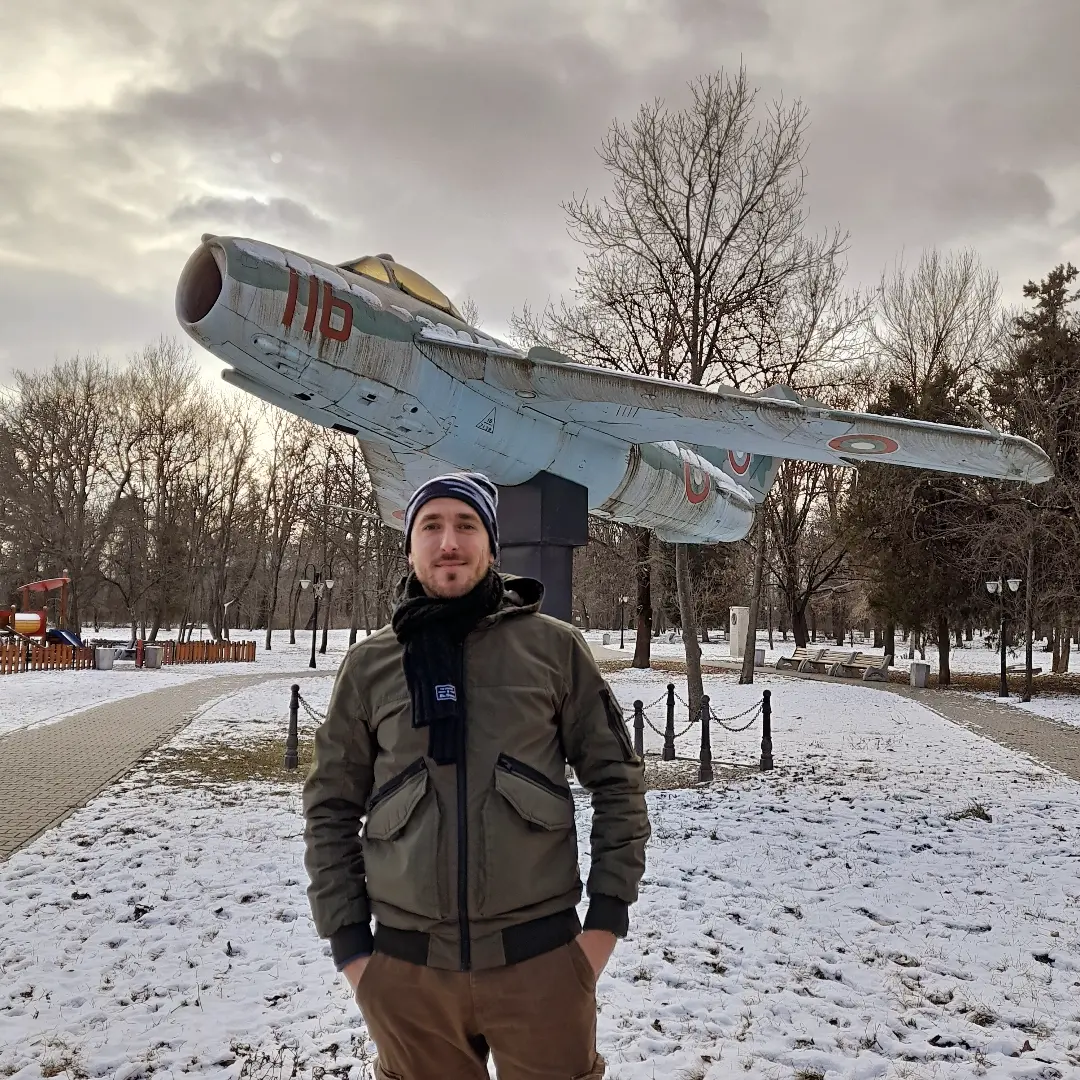 In front of a MiG-17 displayed in a Bulgarian park
I began collecting historical objects at twelve, at flea markets. I grew up between the First World War battlefields of Alsace and the Second World War bunkers of southern France; material history has always been my way into the past.
On settling in Sofia, I narrowed the collection to a single subject: the forty-five years of Bulgarian communist rule. Uniforms, decorations, administrative documents, technical equipment, printed matter, everyday objects.
None of it was acquired from institutions or families. The objects come from flea markets, classified ad sites, online auctions, house clearances — and sometimes skips. Part of what is shown here had been thrown away.
That is worth keeping in mind while browsing the entries. A work record book, a dues booklet, a traffic paddle were not preserved because anyone judged them valuable: they survived because someone bent down and picked them up. What the country deliberately kept were the decorations and the parade uniforms. The rest was lost to indifference.
The collection now runs to several hundred pieces. Two hundred and eighty-five are presented here: those that have been photographed and documented. The rest are waiting. A museum run by one person moves at the pace of one person, and putting an object online takes longer than acquiring it.
A private collection does not carry the authority of a public archive. It does, however, have one advantage: it preserves what no one thought worth preserving. A work record book, a traffic control paddle, an amateur sports badge appear in no national inventory. Yet these are precisely the objects that best convey what an ordinary life under that regime actually was.
Method
Every thematic dossier follows the same rules.
Facts involving dates, figures or names are verified against sources before being written. Each dossier closes with a line that explicitly separates three categories: what is established by a consultable source, what rests on reading an object without documentary confirmation, and what comes from oral testimony. Where sources diverge — on a production figure, a headcount, a date of reorganisation — the divergence is flagged rather than resolved.
No striking figure is repeated without verification. Several estimates that circulate widely about this period prove poorly sourced on examination; they do not appear here.
External archival images are used only where public domain status is established. Photographs of objects are my own.
Register
The history of communist Bulgaria tends to be told in one of two ways: wholesale condemnation, or nostalgia. This site refuses both.
A border guard's uniform is at once the insignia of a corps Bulgarians took pride in and the equipment of a system that cost the lives of people trying to leave. A young pioneer's cap is at once a component of a political apparatus and the headgear of a seven-year-old. The museum's task is not to choose between those two readings, but to show that they rested on the same cloth.
This site is a cultural and historical project. It is the instrument of no political ideology.
Why online
Cold War Bulgaria first existed physically. From June 2025 to January 2026, the collection was displayed in a fifty-square-metre space across two floors, on Alexander Stamboliyski Boulevard, in central Sofia.
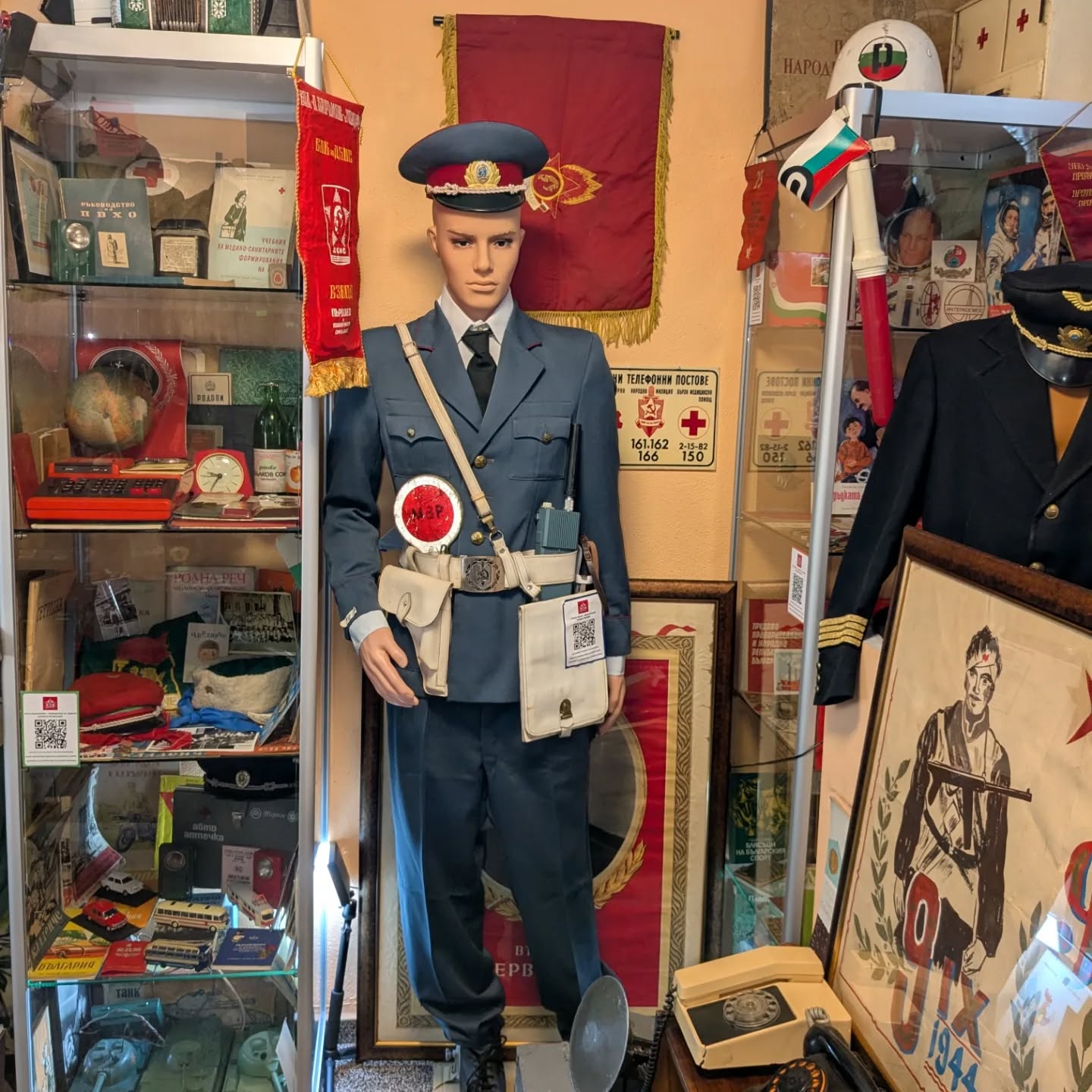 Militia uniform displayed in the Sofia exhibition space
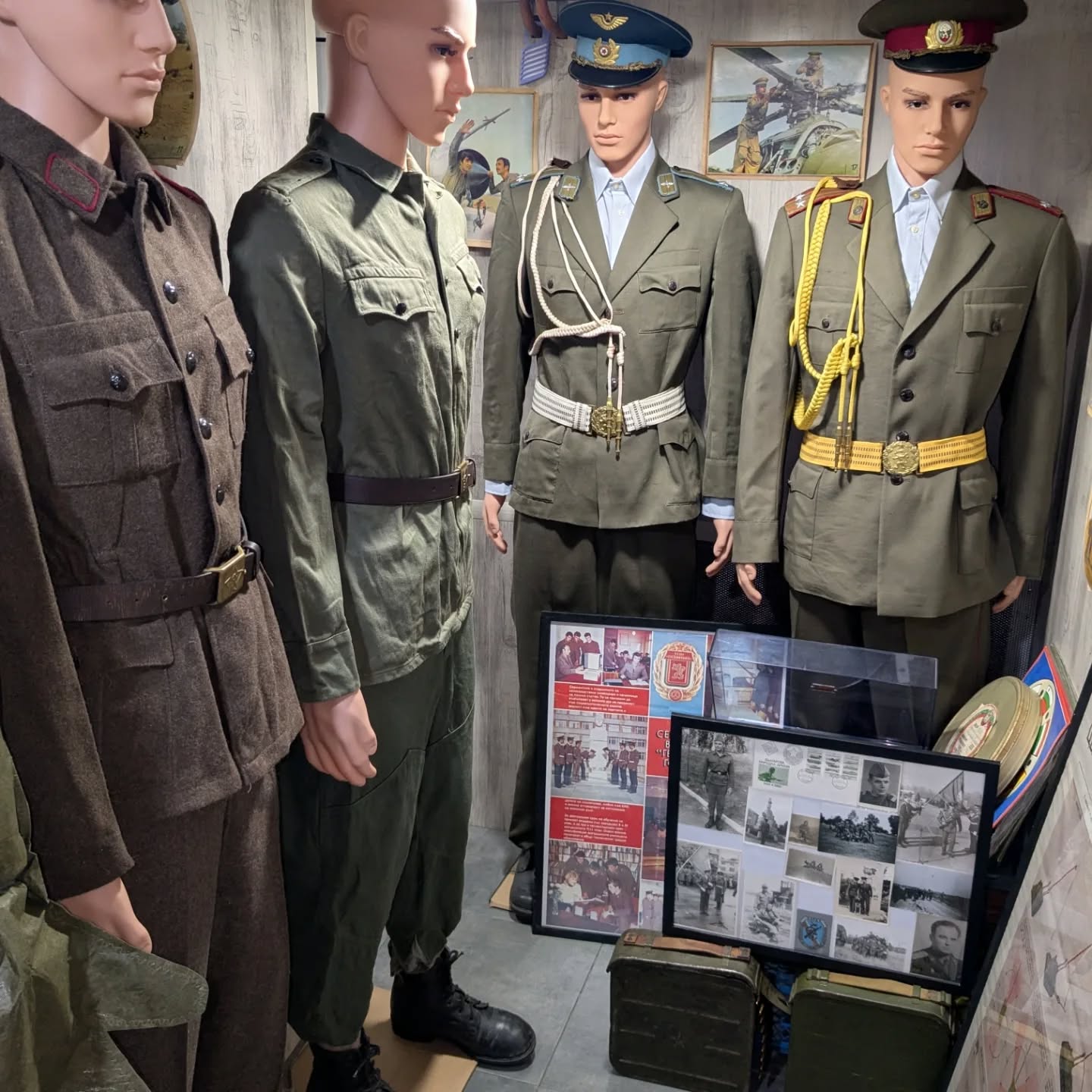 Bulgarian People's Army uniforms displayed in the Sofia exhibition space
Over seven months, the exhibition received around thirty visitors. Over the same period, the accompanying website was recording more than a thousand visits a month.
The gap was unambiguous. An audience for this history exists, but it is not in Sofia: it is scattered, international, and it reads rather than travels. A physical museum in the centre of one capital could not reach it; an online museum in ten languages can.
Closing the space did not therefore end the project. It defined its format.
Contact
For any question concerning the objects, the sources, a reproduction request or a proposed collaboration: contact@coldwarbulgaria.com
The photographs and texts on this site are protected. Reuse, including for educational or editorial purposes, requires prior written permission. Requests are considered case by case and are generally granted for non-commercial use.
Researchers, curators and teachers who need additional views of an object, precise measurements, or unpublished material may write to the same address.