Third in the table
Thematic dossier · Period: 1944–1989 · Reading time: 7 min
A country of nine million inhabitants, eight gold medals and a state method.
At the Moscow Olympic Games in 1980, Bulgaria finished third in the medal table. Eight titles, sixteen silver medals, seventeen bronze: forty-one in all, from two hundred and seventy-one athletes competing in twenty sports.
A country of nine million inhabitants does not finish third at the Games by accident. It gets there because an entire apparatus was built for it, an apparatus whose parts this still life contains.
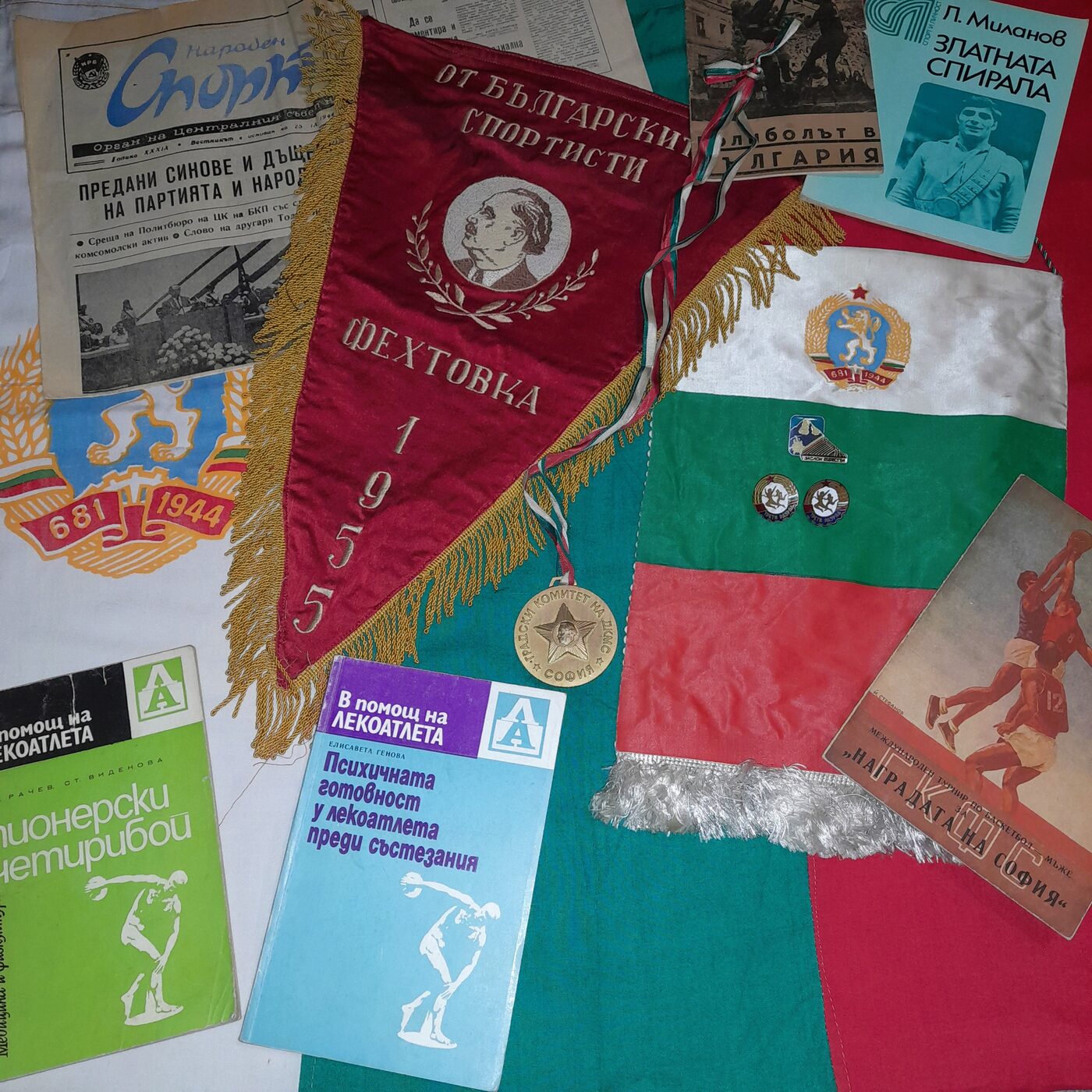 Objects of Bulgarian sport: fencing pennant from 1955, the newspaper Naroden Sport (Народен спорт), Sofia Komsomol medal, training manuals and competition programmes — Collection Cold War Bulgaria
A sports paper that writes about the Politburo
Let us begin with the newspaper. Naroden Sport, People's Sport, is the organ of a central council, as its subtitle indicates. And its front page resembles no Western sports daily.
The headline speaks of "sons and daughters devoted to the Party and the people". Below it, two cross-references: a meeting of the Politburo of the Central Committee, and a speech by Comrade Todor Zhivkov before Komsomol activists.
A sports paper whose front page is occupied by the general secretary and the Politburo. This is not an editorial aberration: it is the very definition of sport in this system. It did not exist as a domain separate from politics, it was a branch of it.
The medal comes from the youth organisation
The next object confirms the same logic by another route.
This gilded medal was not awarded by a sports federation. It bears the inscription of the Sofia Municipal Committee of the ДКМС: the Komsomol, the Party's youth organisation discussed in another dossier of this museum.
In other words, it was the political organisation of youth that rewarded athletic performance. The "Pioneers' Tetrathlon" booklet, lying beside it, says the same thing one notch lower: competition began among children of nine to fourteen, within the framework of their organisation.
A gifted child was not spotted by a club. He was spotted where all children already were.
Above it all, a single organisation oversaw the whole: the Bulgarian Union for Physical Culture and Sport. One was a member, with a booklet, as one was of a trade union or a youth organisation.
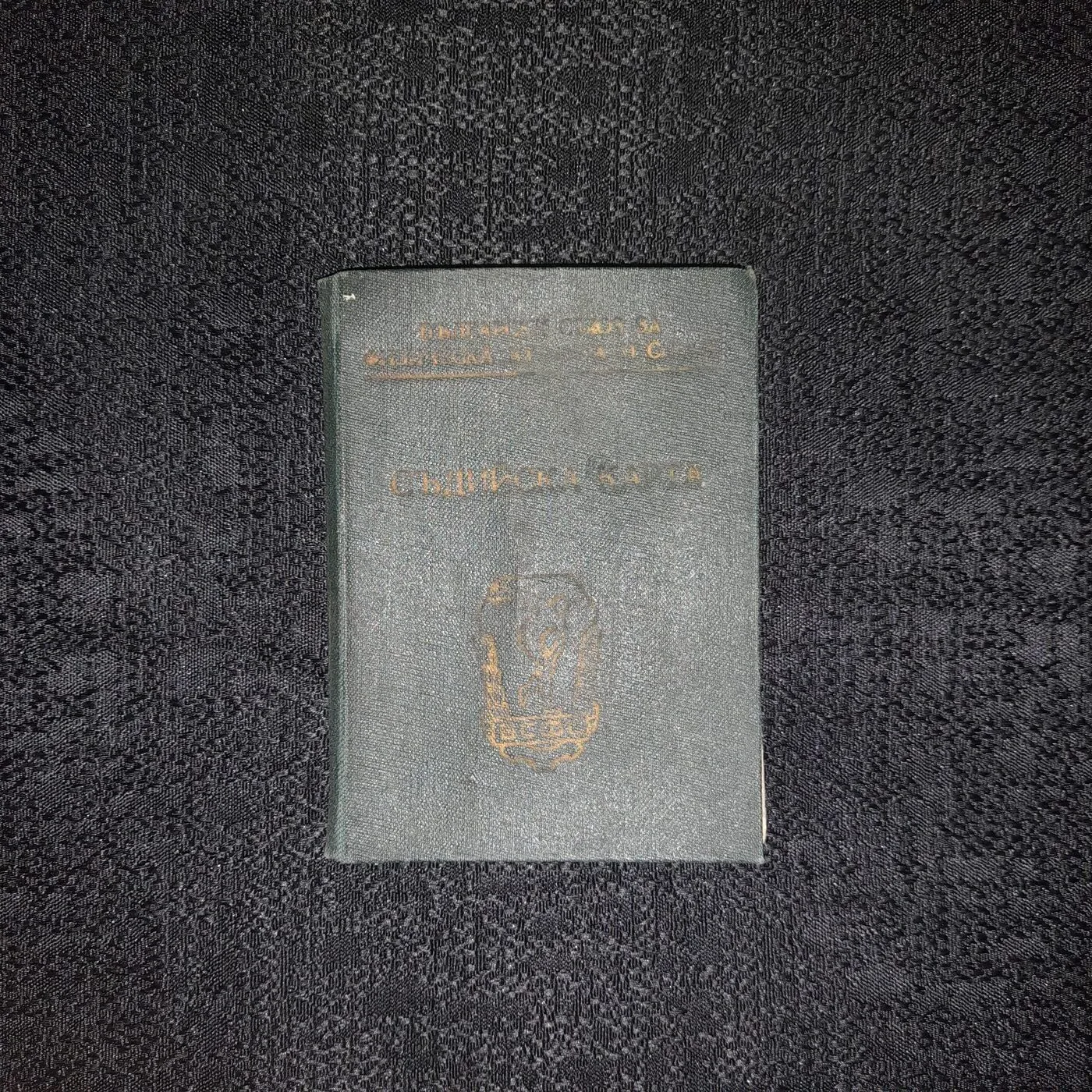 Membership booklet of the Bulgarian Union for Physical Culture and Sport — Collection Cold War Bulgaria
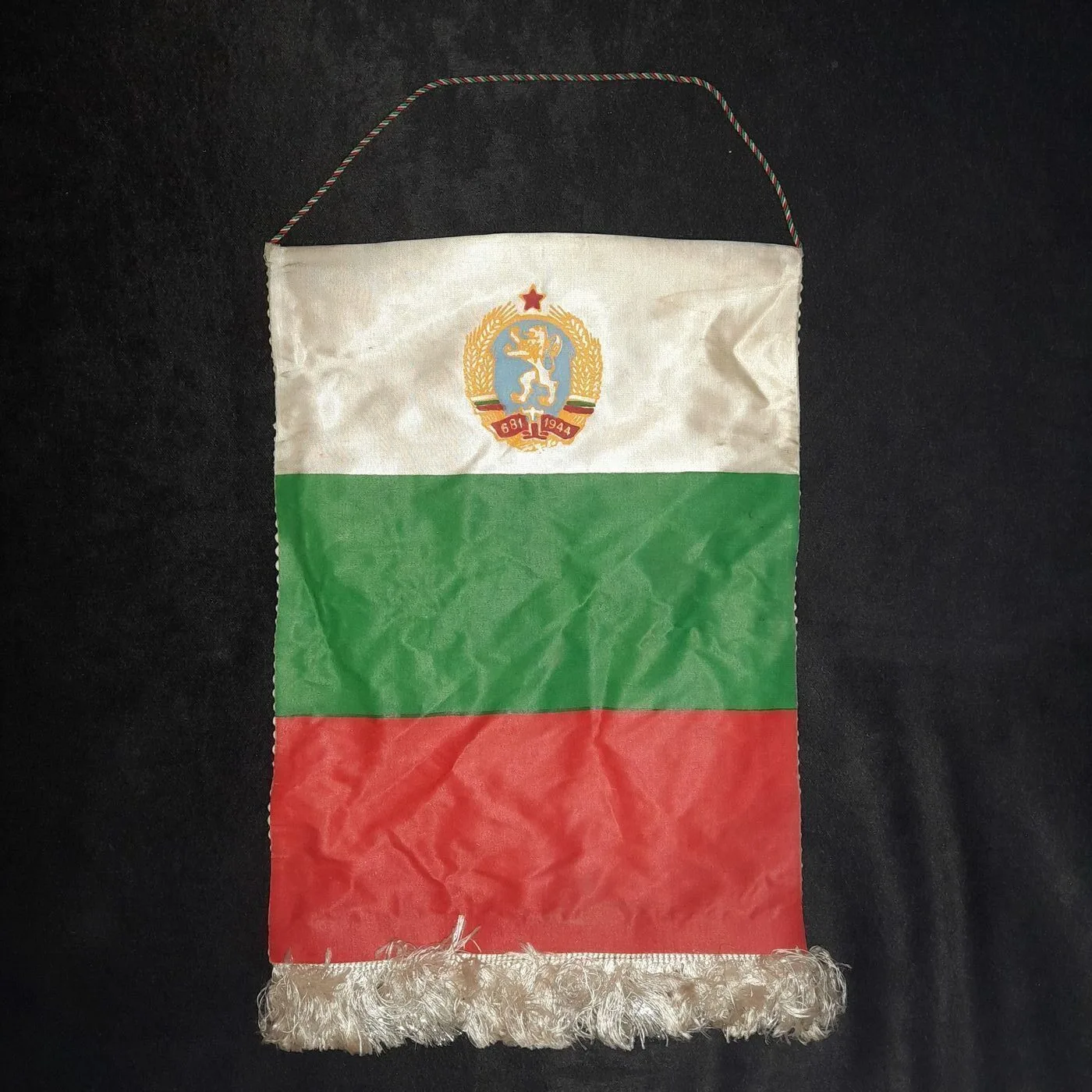 Sports pennant of the People's Republic of Bulgaria, 1983 — Collection Cold War Bulgaria
A technical literature
Next comes what truly distinguishes a state sports system from a simple encouragement to exercise.
Two volumes of a series entitled "In Aid of the Athlete", recognisable by their logo and by the ancient discus thrower on the cover. One of them, by Elisaveta Genova, concerns the psychological preparation of the athlete before competition. Beside it, a work on volleyball in Bulgaria, and "The Golden Spiral" by L. Milanov.
A publishing series devoted to mental preparation, published in a small Balkan country: this presupposes researchers, budgets, and a readership of technical staff able to read such literature. Bulgarian sport had its applied science.
That is the context in which to understand the fencing pennant of 1955, embroidered in velvet and gold thread. Fencing is not a mass sport; it is a club discipline, costly in equipment and coaching. That it should have an official pennant as early as 1955 indicates an early and broad investment, well beyond the disciplines that paid in medals.
Ready for Labour and Defence (Готов за труд и отбрана)
It should not be thought that all this apparatus was aimed solely at champions. Mass sport had its own arrangement, and it bore a name that says everything.
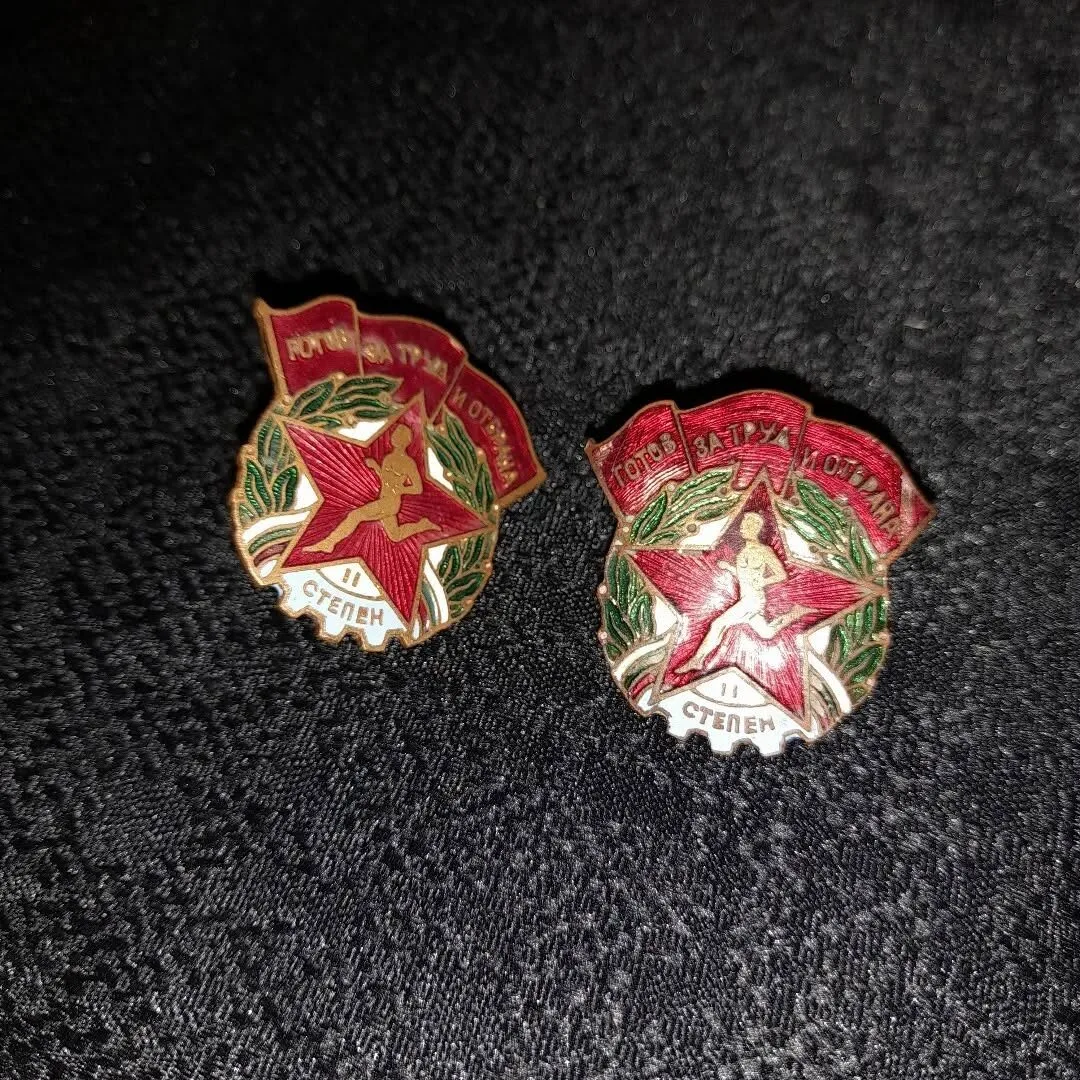 "Ready for Labour and Defence" sports badges, second class — Collection Cold War Bulgaria
"Ready for Labour and Defence": the formula, taken from the Soviet model, explicitly associates physical exercise with two ends that are not sporting. One does not run in order to run. One runs in order to produce and to fight.
The programme worked by tests and by classes (running, jumping, throwing, sometimes shooting) sanctioned by an enamelled badge that was worn. This one bears the mark of the second class: the amateur sportsman too had his rank, and that rank was visible.
An entire population was thus invited to rank itself. Sport was not a pastime one takes up or not: it was a ladder on which everyone occupied a rung.
What the method was worth
The results followed, and they were considerable.
Across all the Summer Games, wrestling remains Bulgaria's leading sport with seventy-three medals including eighteen titles, ahead of weightlifting and its thirty-nine medals. The vast majority of these successes date from the state programmes of the 1960s to the 1980s.
In weightlifting, one method even founded a school under the name "Bulgarian system", attached to the name of the coach Ivan Abadzhiev, who trained twelve Olympic champions and fifty-seven world champions. His methods were reputed to be harsh. In 1984, Bulgarian weightlifters held twelve of the thirty world records.
The other part must be told. Bulgarian weightlifters were the subject of repeated doping accusations, and several positive cases were established at the 1988 Games. The matter resurfaced long after the fall of the regime: in 2008, the entire squad preselected for Beijing tested positive, and the federation withdrew its whole delegation, a first in its history.
The collapse
The clearest proof of what the system was worth is what happened when it disappeared.
In 1988 at Seoul, Bulgaria won thirty-five medals including ten titles. In 1992 at Barcelona, four years later: eighteen medals including five titles. Half, in a single Olympiad.
The explanation is structural. Sport was centrally planned and subsidised; the move to a market economy brought the privatisation of facilities and the end of guaranteed public support, obliging sports organisations to compete for resources that had become scarce. The Bulgarian anthem has not been played at the Olympic Games since 2008.
What a sports display case shows
These objects recount a real achievement and a questionable mechanism, without the two being cleanly separable.
A real achievement: athletes worked, suffered, won. Coaches invented methods that are still studied. A small country stood up to the greatest, and the pride Bulgarians took in it was in no way artificial.
A questionable mechanism: this achievement was produced by a state that saw in it a political demonstration, that spotted children through its youth organisations, that led on the Politburo in its sports papers, and some of whose results rested on practices we know about today.
The embroidered pennant of 1955 and the manual of psychological preparation belong to the same arrangement. One celebrates, the other optimises. Between the two are people who got up early for twenty years.
Facts verified against sources: Bulgaria's third place in the medal table at the Moscow Games in 1980, with eight titles, sixteen silver medals, seventeen bronze and two hundred and seventy-one athletes competing in twenty sports; a total of seventy-three Olympic medals in wrestling including eighteen titles, and thirty-nine medals in weightlifting; the concentration of these successes in the state programmes of the 1960s to the 1980s; the career of Ivan Abadzhiev, twelve Olympic champions and fifty-seven world champions trained, the reputed harshness of his methods, and twelve of the thirty world records held by Bulgarian weightlifters in 1984; recurrent doping accusations and positive cases established at the 1988 Games; the positive test of the entire squad preselected for Beijing in 2008 and the withdrawal of the delegation; the fall from thirty-five medals including ten titles at Seoul in 1988 to eighteen medals including five titles at Barcelona in 1992; central planning and subsidy of sport, the privatisation of facilities after the transition and the end of guaranteed public support; the absence of the Bulgarian anthem from the Games since 2008. Resting on a reading of the objects photographed and not on a documentary source: the identification of the newspaper Naroden Sport and its front-page headlines, the attribution of the medal to the Sofia Municipal Committee of the ДКМС, the dating of the fencing pennant to 1955, and the identification of the works in the "In Aid of the Athlete" series. The identification of the "Ready for Labour and Defence" badges as belonging to the Soviet-inspired mass fitness programme rests on the designation borne by the objects; the detail of the Bulgarian tests and standards has not been verified against sources and is described from the general model. The spotting of sporting children by the youth organisations is inferred from the presence of the pioneers' tetrathlon booklet and the Komsomol medal, not from a source describing the procedure.