Zero leva twenty-two
Thematic dossier · Period: 1944–1989 · Reading time: 5 min
A road map, a telephone, a torch: the ordinary objects of a country where nothing was ordinary.
On the cover of a road map of Bulgaria, beneath the publisher's name (the Main Directorate of Geodesy and Cartography) appears a price: 0.22 leva. It is printed there, in the paper, like the title or the edition number.
A printed price is a strange object for a reader today. It assumes that it will not change, that it will be the same in Sofia and in Vidin, in this shop and in the one opposite, this year and next. It results from no negotiation, no competition, no season. It was decided, and then engraved.
It is through this detail that one best enters Bulgarian daily life of the period. Not through what was spectacular about it, but through what was fixed.
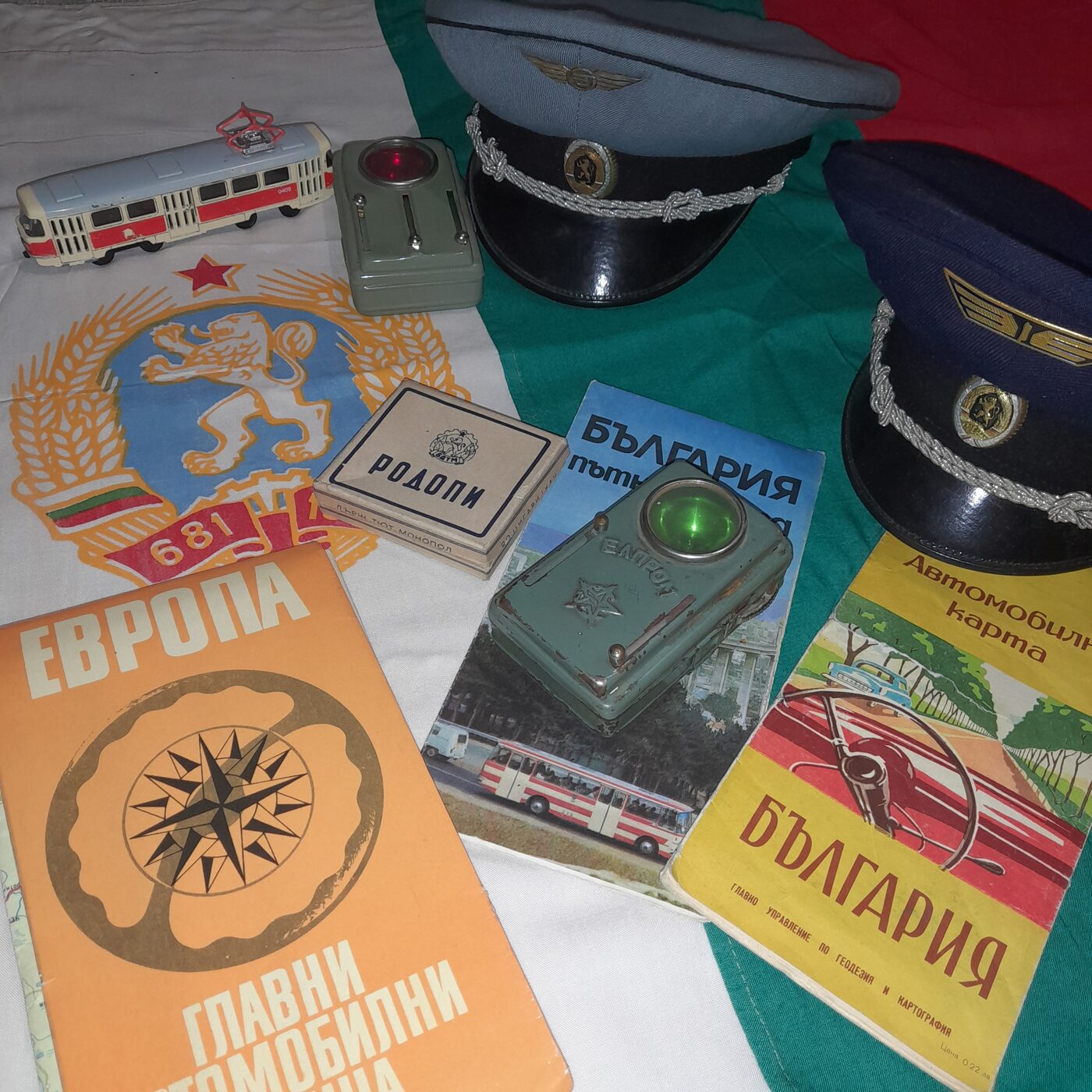 Everyday objects in the People's Republic of Bulgaria: road maps, transport staff caps, miniature tram, cigarettes and torch — Collection Cold War Bulgaria
Getting about
The road map of Bulgaria and the atlas of Europe's major roads together raise an interesting question. What use is a European atlas in a country one can only leave with permission?
The answer is less ironic than it appears: there was a good deal of travel within the bloc, and the maps served first of all professionals, drivers and organised tours. But the object retains something troubling. A map is an invitation; this one offered a continent half of which was closed.
For most people, daily movement went by public transport.
Two service caps, with their winged badges and their braided cords: driving a tram or a bus was a job in uniform. Transport was not one service among others, it was a public function, with its ranks and its insignia.
The tram appears again in miniature, in painted tin in the network's colours, a toy reproducing what the child watched passing beneath the windows.
Light and calls
The home is told through three objects.
A dial telephone, pale green, with its rotary numbering and its coiled cord. Owning a line was not a given: the connection had to be applied for and waited for, and the wait could be long.
A set in brown and cream Bakelite, the rounded shape of the fifties, which occupied in the living room the place a screen occupies today.
And torches, several of them, in moulded plastic in bright colours: green, red, grey. Their number in a collection is not incidental: in a country where power cuts were part of life, a torch was not a camping accessory.
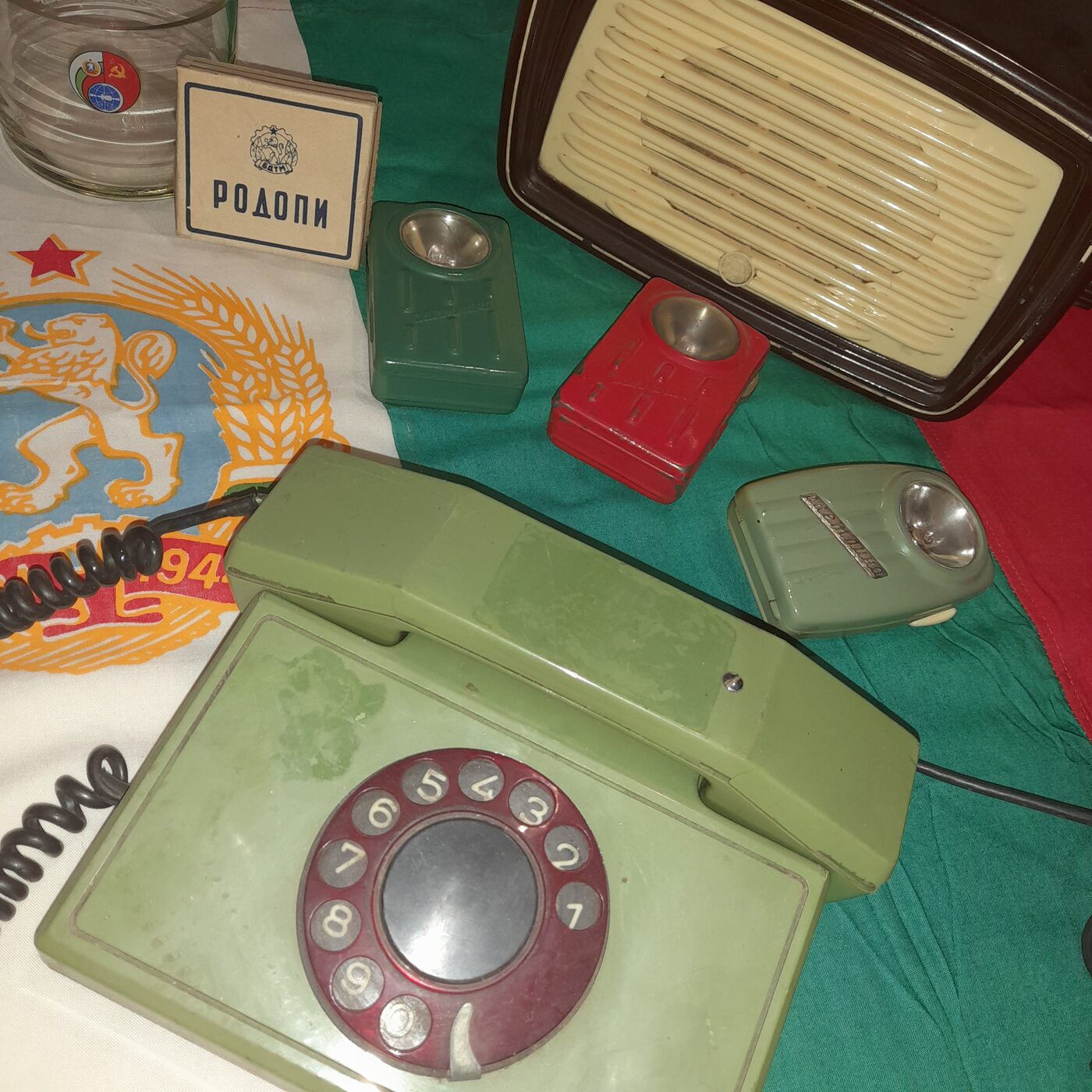 Dial telephone, Bakelite set, torches and glass engraved with the emblems of the socialist countries — Collection Cold War Bulgaria
The engraved glass deserves a word. It bears the emblems of several countries of the bloc, a table object decorated with a political geography. People drank from it every day.
Smoking
A packet of Rodopi cigarettes, bearing the emblem of the state tobacco monopoly.
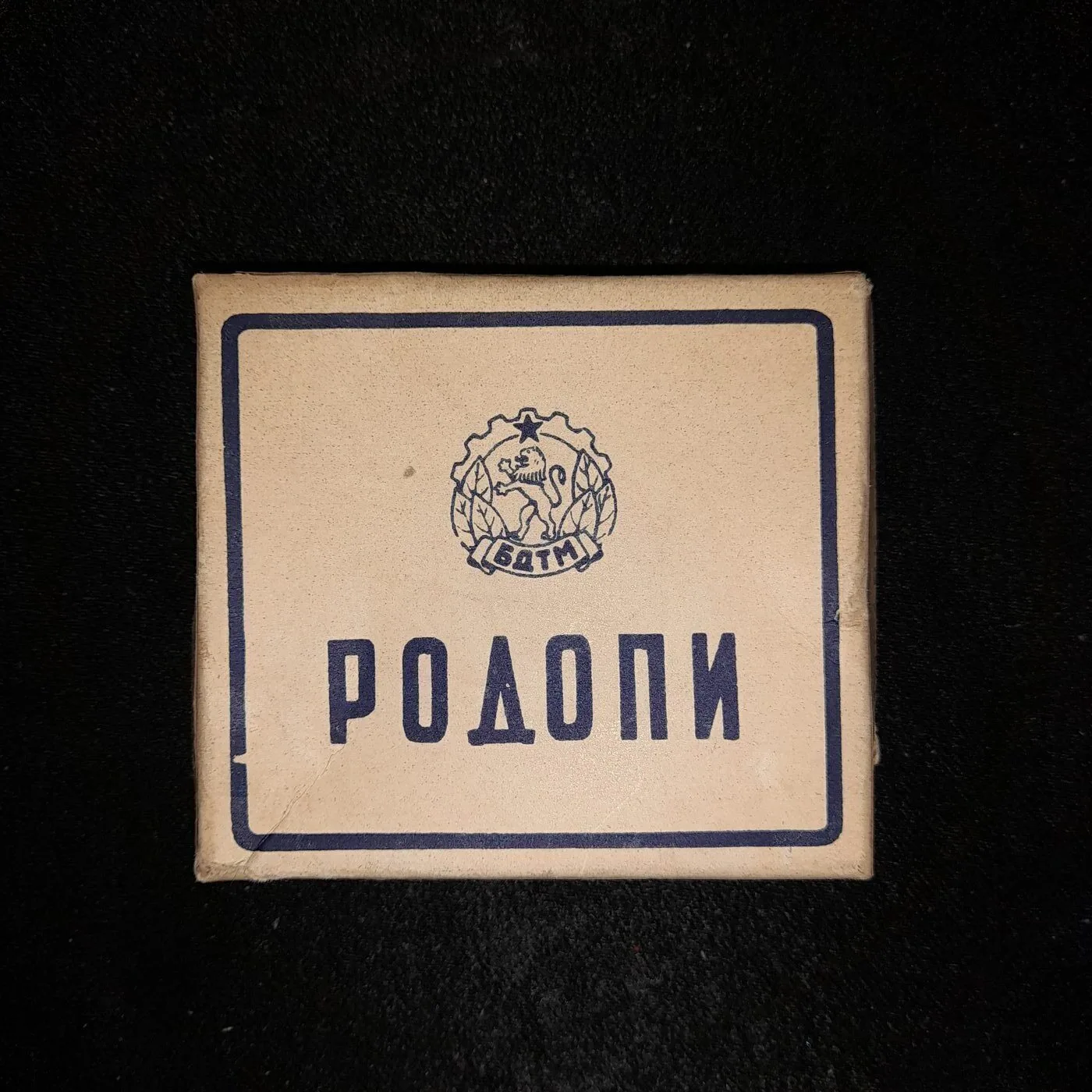 Packet of cigarettes of the Bulgarian brand Rodopi — Collection Cold War Bulgaria
Behind this ordinary packet lies one of the regime's greatest economic successes, and it is little known. The state tobacco monopoly, renamed Bulgartabak (Булгартабак) in 1954, made Bulgaria the world's leading exporter of cigarettes between 1966 and 1988, in some years second behind the United States. About ninety per cent of these exports went to the Soviet Union.
By the end of the 1980s, factory capacity reached seventy-five billion cigarettes, three times domestic consumption. And that domestic consumption was not slight: in 1982, half the population smoked, and a quarter worked in the tobacco industry.
A small country of nine million inhabitants thus supplied a good part of the Eastern bloc with cigarettes. The packet of Rodopi is not a banal consumer object: it is a sample of the country's principal bargaining currency.
Counting
A final group closes the sequence, and it returns to the printed price of the opening.
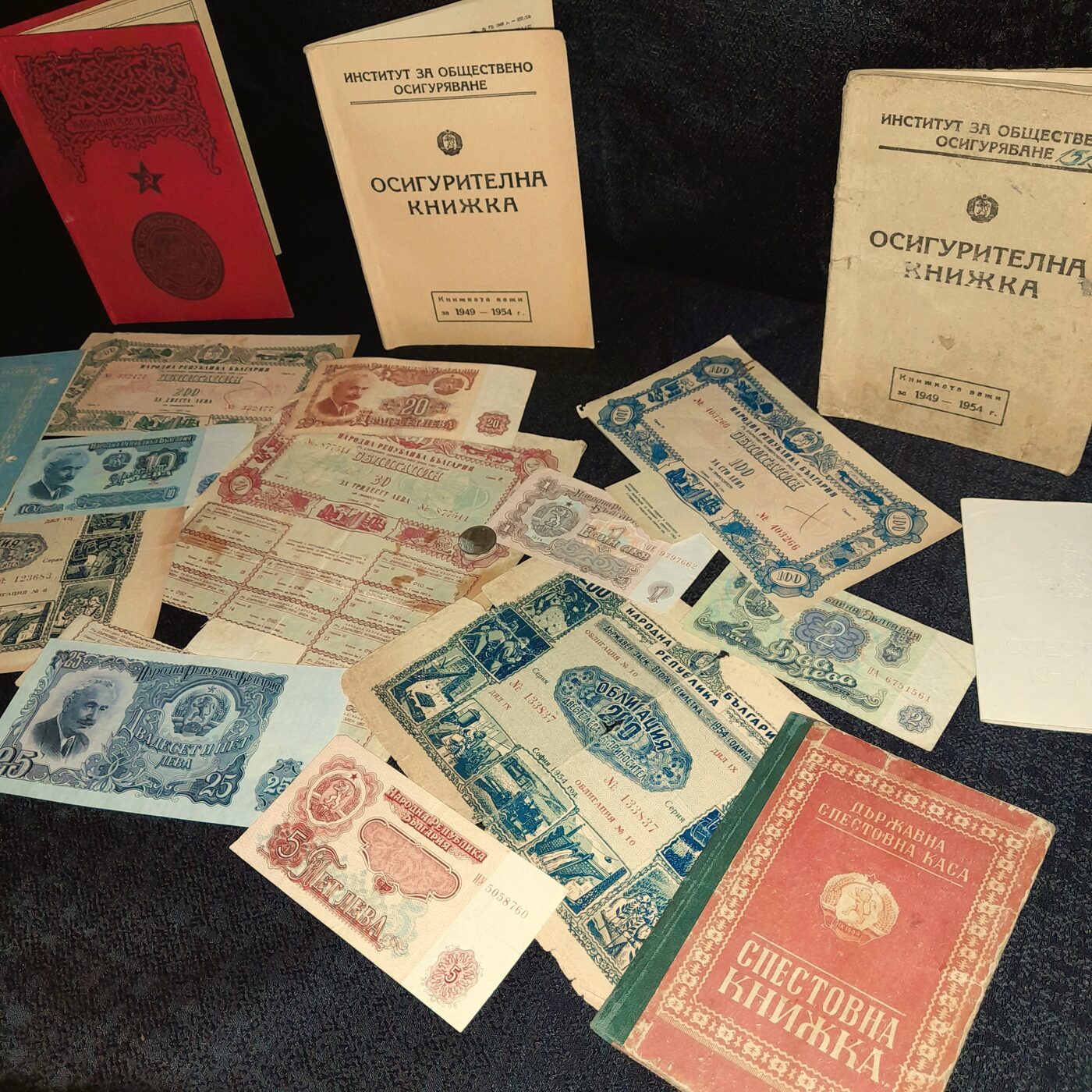 Social insurance books, State Savings Bank passbook, state loan bonds and banknotes in leva — Collection Cold War Bulgaria
Notes of one, two, five, ten, twenty and twenty-five leva, several bearing the likeness of Georgi Dimitrov. A passbook of the State Savings Bank (Държавна спестовна каса). Social insurance books. State loan bonds.
There was only one savings bank, a single borrower, a single currency with no free exchange. The money of a Bulgarian household circulated in a closed circuit, from wage to savings and from savings to the financing of the plan. A twenty-five leva note and a road map at twenty-two stotinki belong to the same system: the one in which the value of things is decided elsewhere.
What is not in the display case
It is worth saying what this collection does not show, because the absence is instructive.
There is almost no crockery, no furniture, no civilian clothing, no kitchen utensils, no toys apart from the tram. These are nonetheless the most numerous objects in any life. They are missing because they were used to the end, thrown away, replaced, and because no one judged them worth keeping.
What survives of a period is not what made it up in the greatest quantity. It is what carried an emblem, a badge, a printed price. Real daily life, that of meals and ordinary mornings, leaves almost nothing behind.
So one guesses at it through its edges. Through a driver's cap, a torch, a price that does not move. Through a packet of cigarettes that, announcing nothing, tells the entire economy of a country.
Facts verified against sources: the renaming of the state tobacco monopoly as Bulgartabak in 1954; Bulgaria's position as the world's leading exporter of cigarettes between 1966 and 1988, in some years behind the United States; the share of about ninety per cent of exports directed to the Soviet Union; production capacity of seventy-five billion cigarettes at the end of the 1980s, three times domestic consumption; the proportion of half the population smoking and a quarter employed in the tobacco industry in 1982; the Rodopi brand's membership of the monopoly's portfolio. Resting on a reading of the objects photographed and not on a documentary source: the identification of the social insurance books, the State Savings Bank passbook, the bonds and the denominations shown; the identification of the caps as belonging to public transport staff, the reading of the price of 0.22 leva and of the publisher on the road map, and the identification of the engraved glass as bearing emblems of socialist countries. The difficulties of obtaining a telephone and the frequency of power cuts are described from a general knowledge of the period in the Eastern bloc, and not from a Bulgarian source consulted here.