The line and its keepers
Thematic dossier · Period: 1946–1989 · Reading time: 8 min
The Bulgarian Border Troops (Гранични войски): a corps apart, a national pride, and the line they held.
On 10 August 1946, the National Assembly passed a law relieving the Ministry of War of the guarding of the borders and establishing within the Ministry of the Interior a directorate of the Border Militia (Гранична милиция). The text specified that its personnel held the rights of servicemen. Published on 27 August, the law was applied that autumn: on 8 October, a decree of the Council of Ministers renamed the corps Border Troops, Гранични войски. The 27th of August would remain their feast day.
This administrative birth already says the essential. The border was entrusted not to the army but to the Interior, that is, to the ministry that also housed the People's Militia and State Security. The corps would nonetheless be military in its organisation, its armament and its uniform. It is this exceptional position that explains all the rest: the prestige, the selection, the iconography, and the exact nature of the mission.
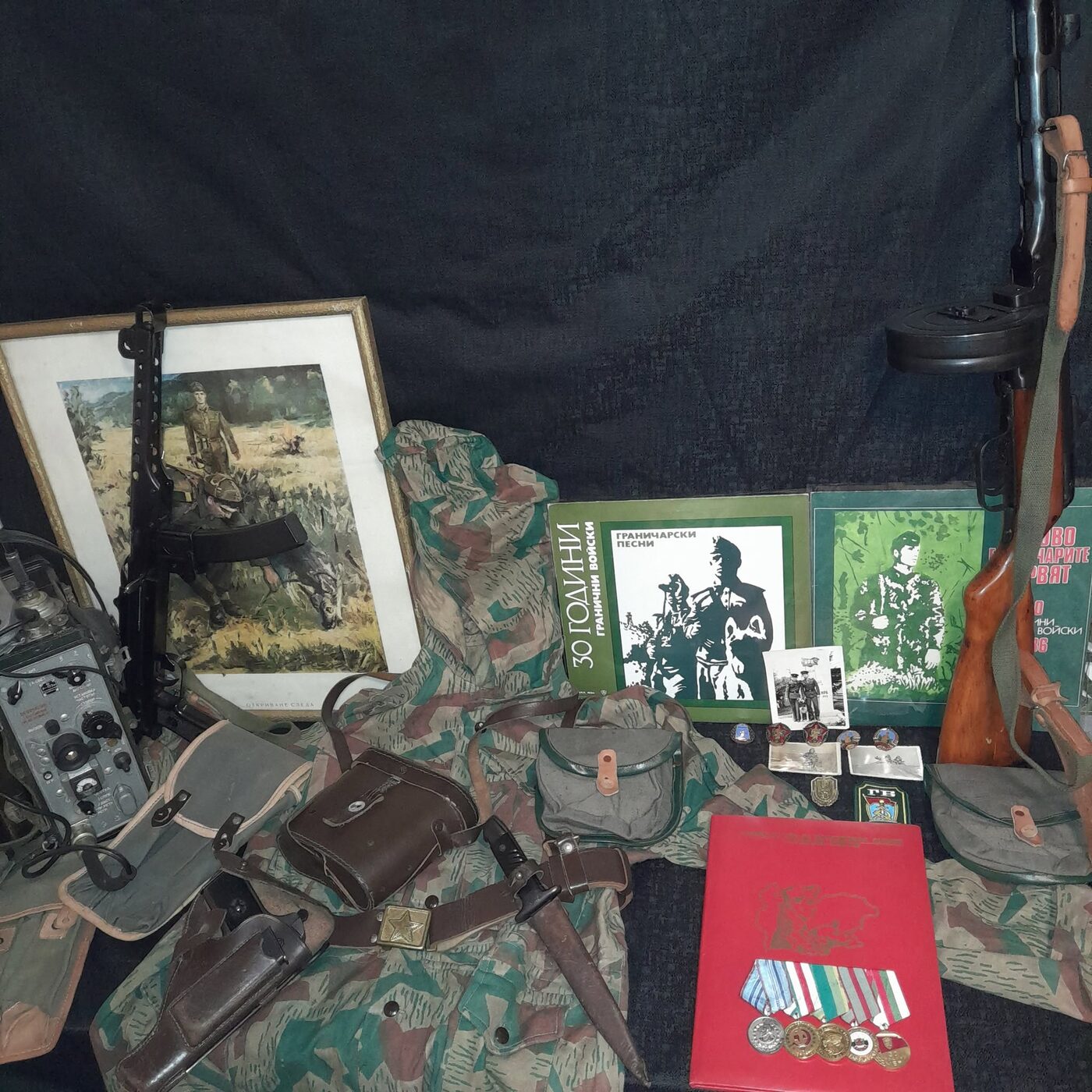 A set of objects of the Bulgarian Border Troops: camouflage uniform, field radio set, weapons, insignia, records and decorations — Collection Cold War Bulgaria
A troop apart
A qualification must be added to what is often said, in Bulgaria too: the Border Troops did not come under the Ministry of the Interior without interruption. From 1962 to 1972 they passed under the Ministry of National Defence, before returning to the Interior for the rest of their existence. The border control posts, for their part, remained with the Interior throughout that decade.
The exception holds true in substance. For most of the period, a young Bulgarian called up could do his service in a military unit, in uniform, with an automatic weapon, without ever coming under the Ministry of Defence. No other troop was in that position.
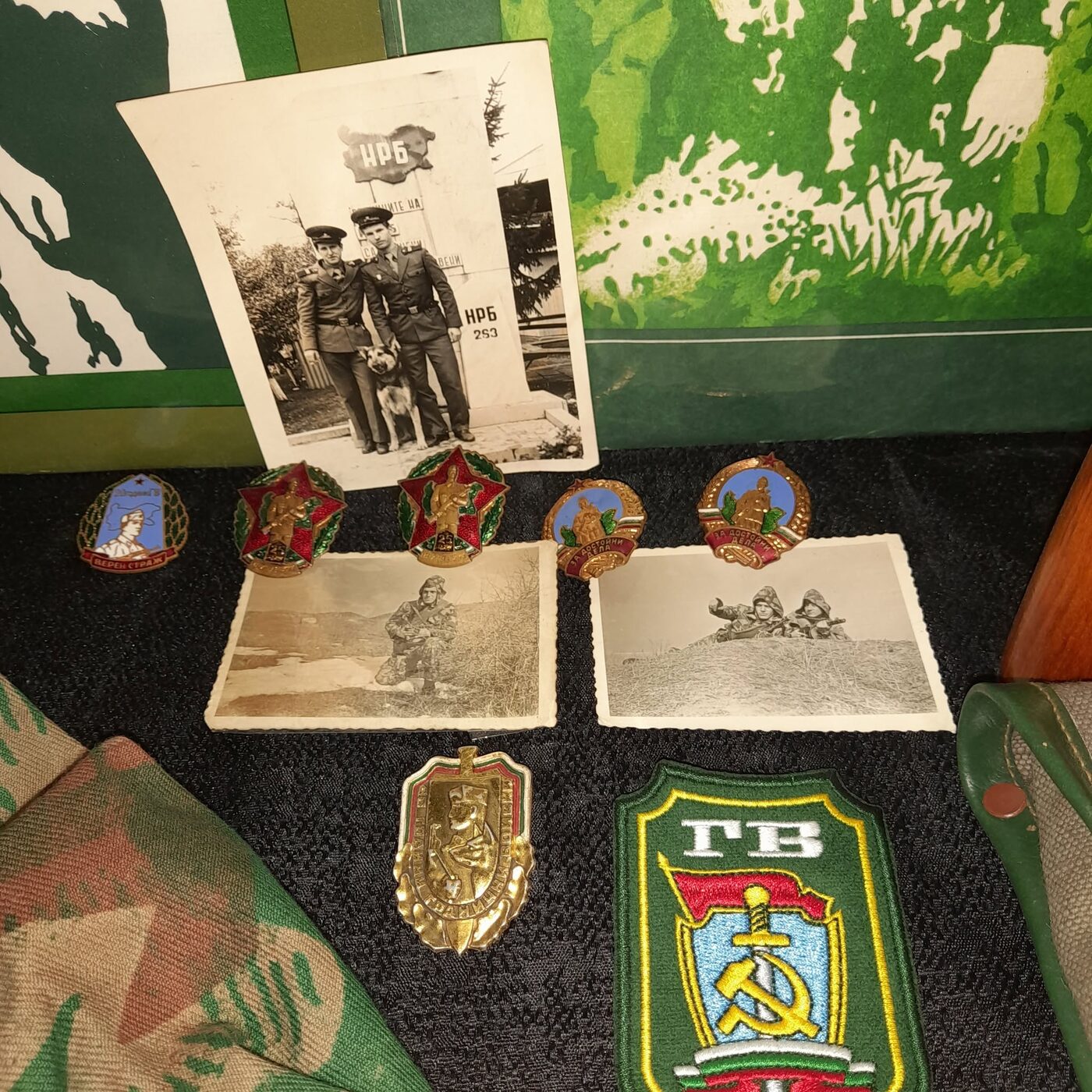 Border Troops insignia, sleeve patch, and photograph of two border guards with their dog before a boundary marker of the People's Republic — Collection Cold War Bulgaria
The best of the boys
From this particular status flowed a reputation. To serve on the borders was worth more than serving elsewhere: it was the posting people spoke of in the village, the one that made a man.
Selection went beyond physical criteria. An oral account collected from a Bulgarian friend describes the recruiters' method: they came to the foot of the apartment blocks and into the villages, and they questioned the grandmothers. Does this boy smoke? Does he drink? Is he a decent person? One had to be sound in body and mind, and that soundness was checked with the neighbourhood before being checked at the recruitment office.
This detail is not incidental. It shows that the recruitment of an elite corps went through the same channel as neighbourhood surveillance: the knowledge people had of one another. One did not consult a file, one asked the babas.
This passage rests on an oral account and not on a documentary source. It renders a lived memory, which has its own value, but it does not describe a verified official procedure.
The green and the dog
An elite corps is also made by its images, and those of the Border Troops are remarkably constant: the green, the mountain, and the dog.
The dog is everywhere. On the photographs of conscripts posing with their German shepherd before the boundary marker. On the record sleeves issued for the corps's thirtieth and fortieth anniversaries, in 1976 and 1986, where the silhouette of the border guard and that of the animal are one. On the framed reproduction showing two men reading a track on the ground, one bent down with the dog, the other standing, weapon on his shoulder.
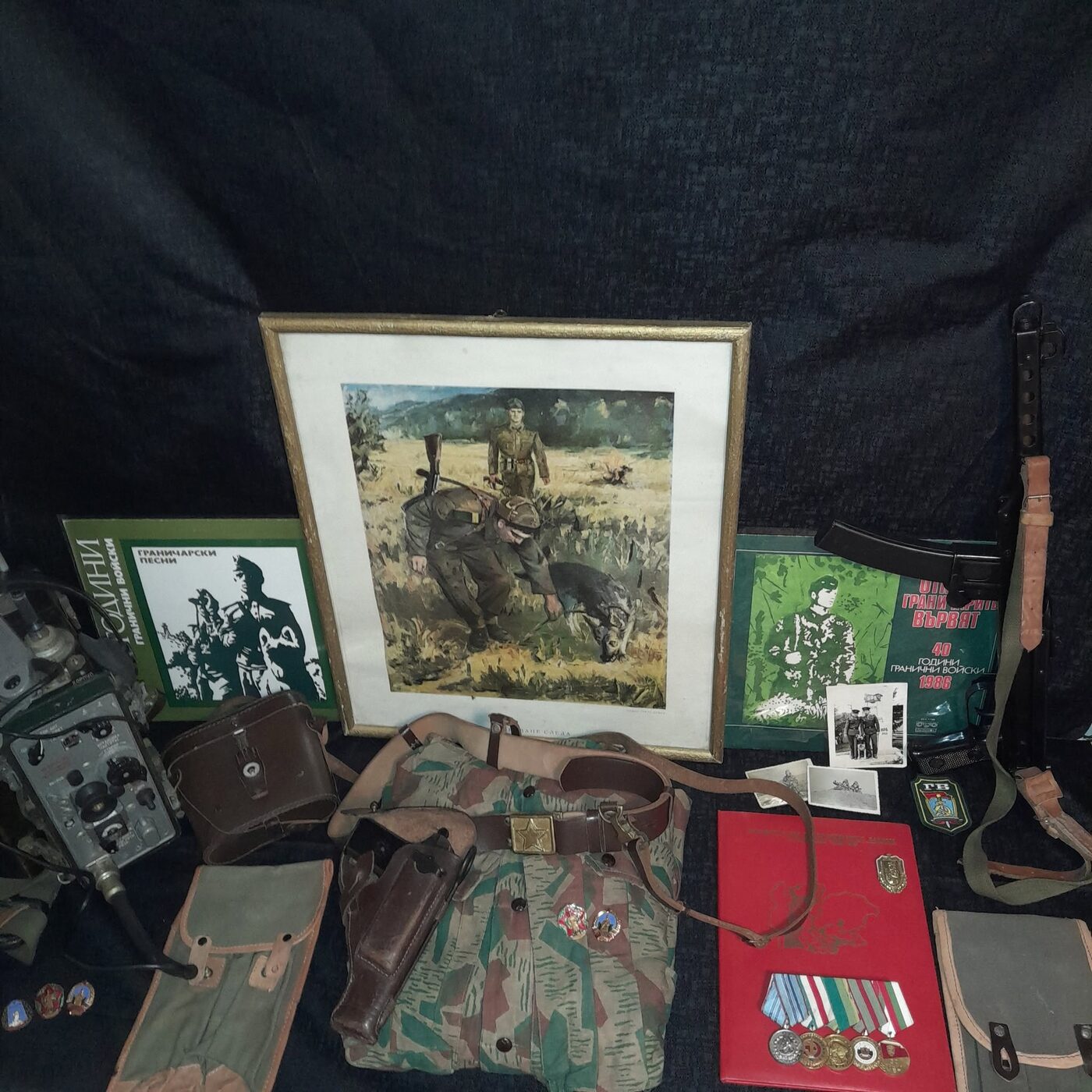 Framed period reproduction showing two border guards reading a track, with their dog, surrounded by records issued for the corps's anniversaries — Collection Cold War Bulgaria
This imagery recounts a precise mission: to detect, to follow, to catch up. Not to defend a position, not to repel an invasion. To read the ground and follow a trail.
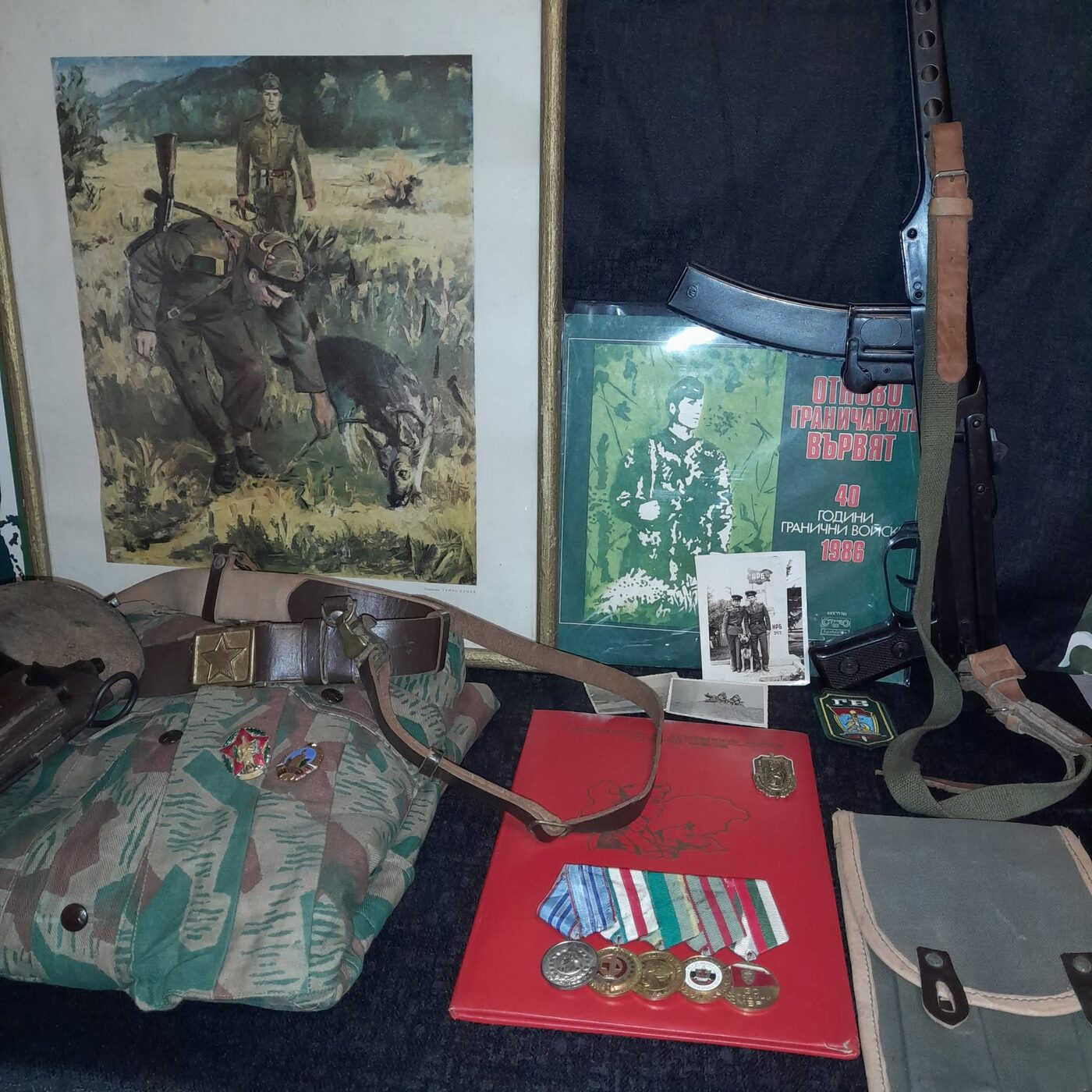 Record issued for the fortieth anniversary of the Border Troops in 1986, submachine gun and issue pistol — Collection Cold War Bulgaria
A patrol's equipment
The materiel confirms the reading. Nothing this troop carries is made for holding a front.
The camouflage dress with its splintered pattern, known as "amoeba", serves for blending into a wooded slope. The leather belt with its star buckle, the pistol holster, the bayonet, the ammunition pouches and the haversacks form a light kit, conceived for walking a long time.
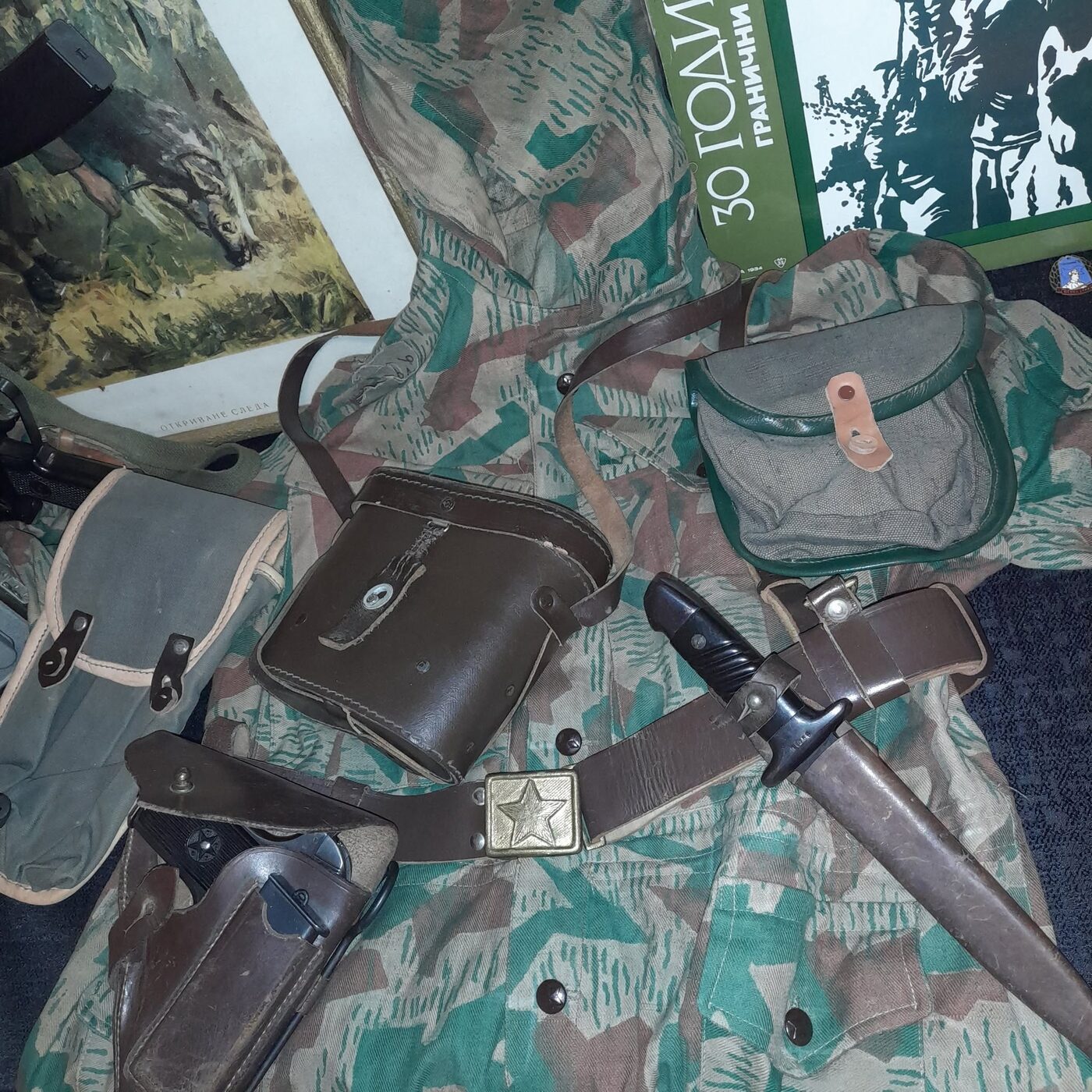 Camouflage dress, star-buckle belt, pistol holster, bayonet, binocular case and haversacks of the Border Troops — Collection Cold War Bulgaria
The R-105M field radio provided the link between patrols and the post. On its front panel, a red inscription in Russian warns the operator that the enemy is listening: the reminder is printed on the set itself, at eye level, every time it is used.
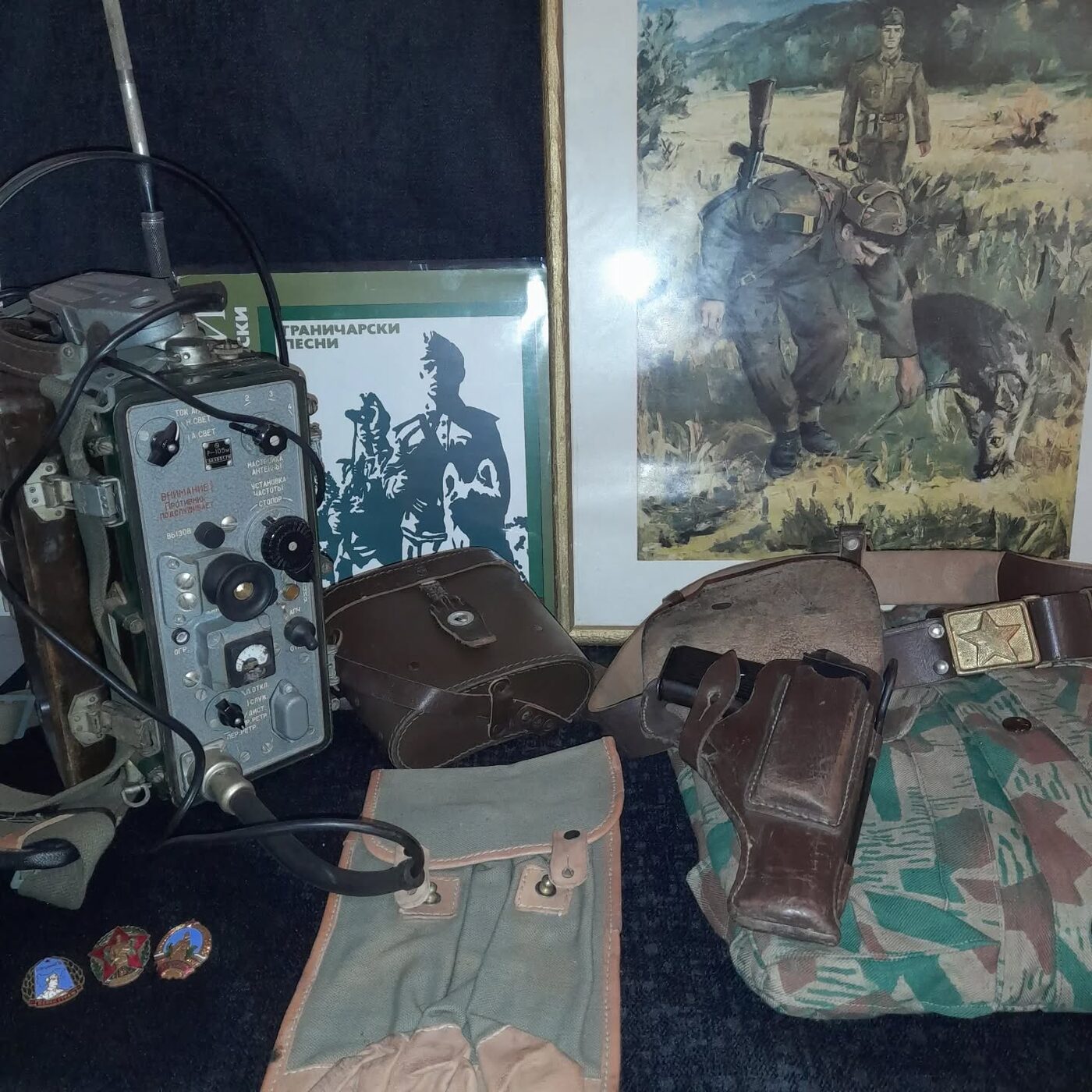 Soviet R-105M field radio set with its headset, used by the Border Troops — Collection Cold War Bulgaria
The rest comes down to two objects. Binoculars, to see before being seen.
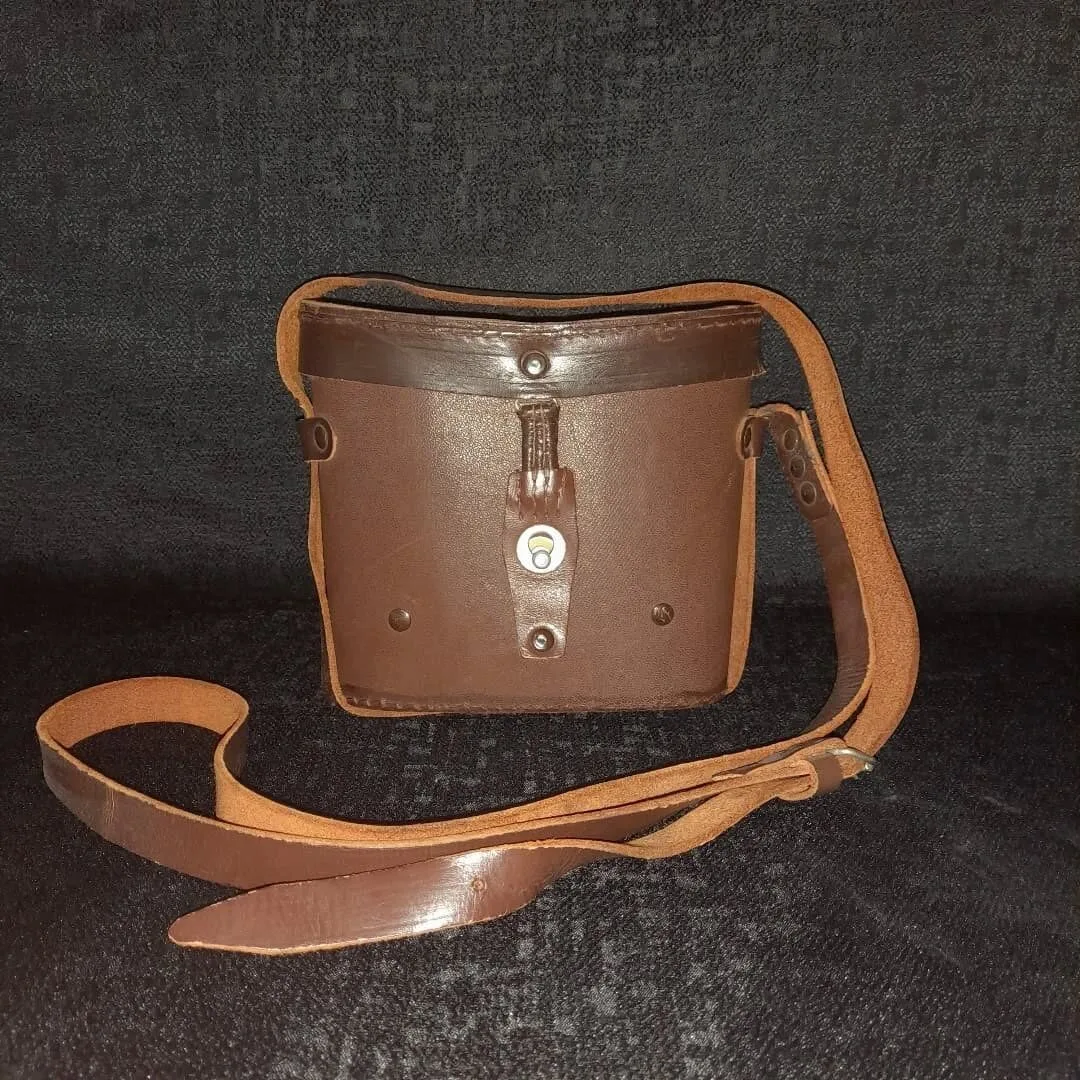 Bulgarian OMZ B 8x30 military binoculars with rangefinding scale — Collection Cold War Bulgaria
And a wrist compass, to hold a bearing at night, in terrain without landmarks.
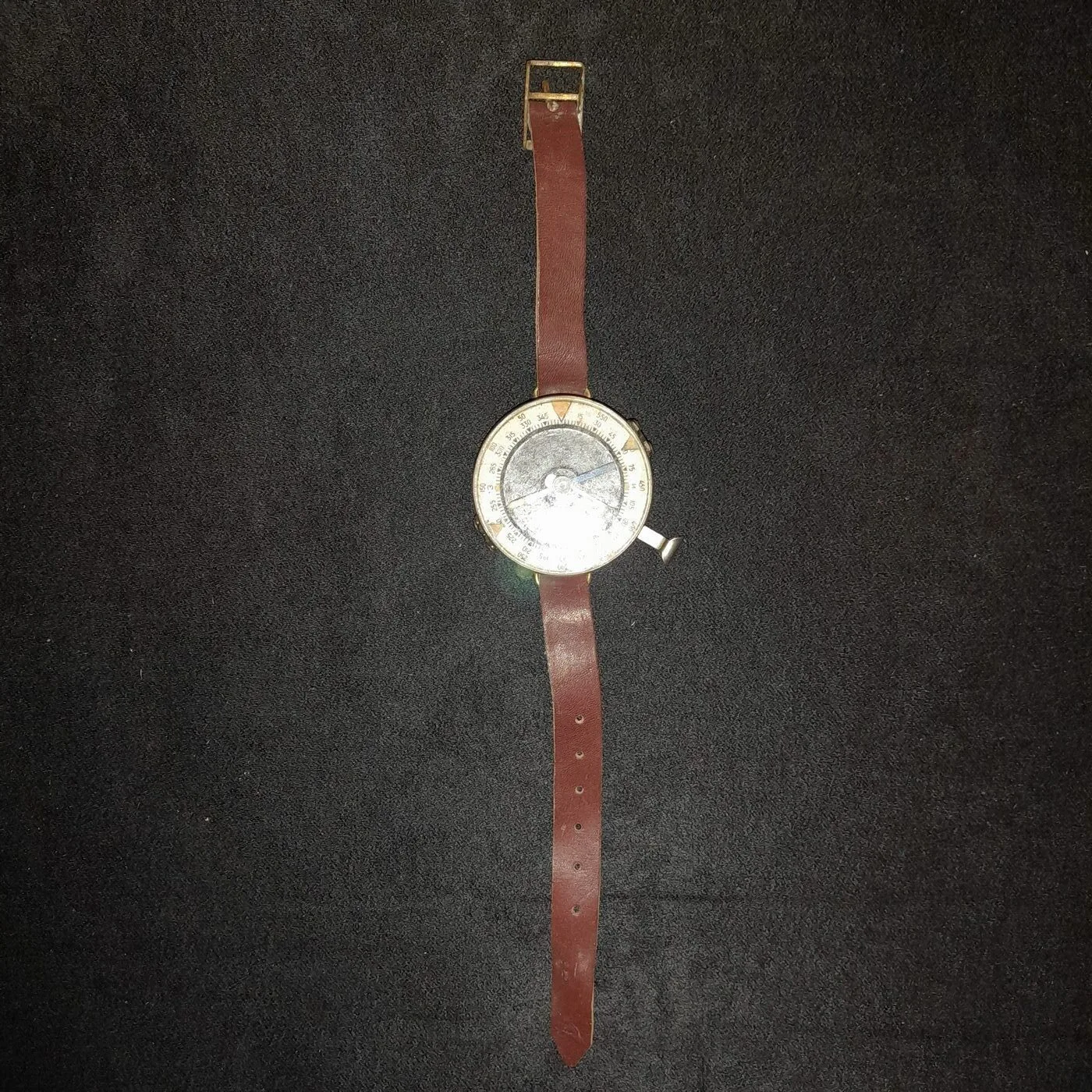 Wrist compass of Bulgarian manufacture — Collection Cold War Bulgaria
The line
It remains to say what this line was.
Bulgaria's southern border was not an ordinary Eastern bloc frontier: beyond it lay Greece and Turkey, two NATO member countries. It was the outer edge of the system, and it was held as such.
This line was not only guarded, it was administered. On 1 January 1948, the passport offices were renamed border control posts and attached to the directorate of the Border Troops. The same corps that read tracks in the mountains stamped passports at the crossing points.
For legal exit did exist. It was simply rare, and warranted. This service passport was issued to a Bulgarian national sent to work in the German Democratic Republic: a professional journey, authorised, within the bloc. He held in a pocket the thing that thousands of people were seeking in the Rhodopes.
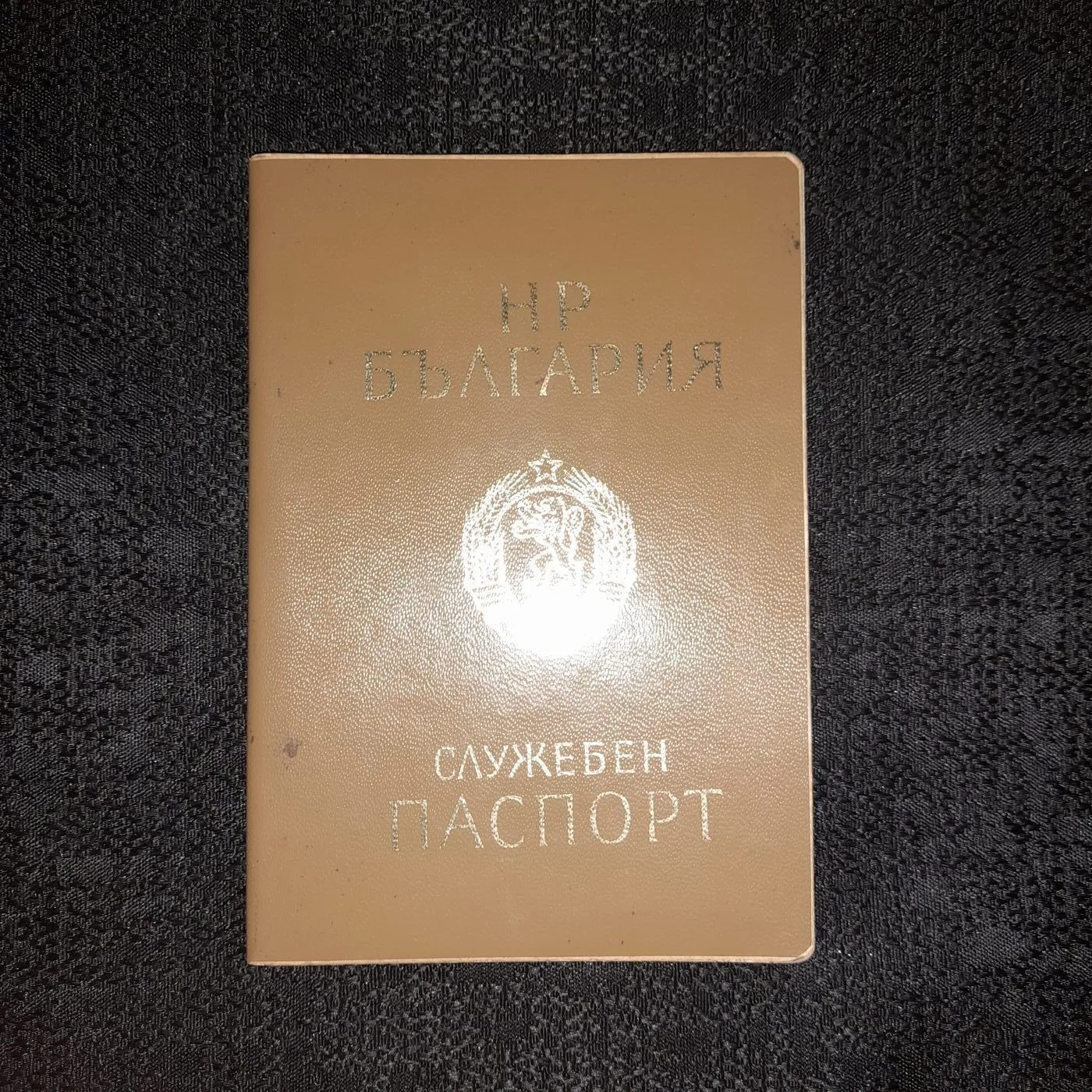 Bulgarian service passport issued for a professional journey, belonging to a person sent to work in the German Democratic Republic — Collection Cold War Bulgaria
There circulated in the German Democratic Republic, nonetheless, a persistent rumour: Bulgaria was said to be the weak point of the Iron Curtain, easier to cross than the inner-German border. Thousands of people set out on that idea. The reality was quite otherwise. Research conducted since the 2000s records twenty-one documented cases of East German citizens killed attempting to cross by the Bulgarian border, at least six hundred and ninety-five successful crossings, and more than one thousand five hundred attempts foiled. The last known death is Michael Weber, nineteen years old, shot in July 1989, a few weeks before the fall.
These figures remain disputed. The historian Stoyan Raychevski, co-author of a study of these attempts, stresses that the work is difficult because the Bulgarian archives contain no summary data, and that the Stasi archives have often proved more useful. Other researchers advance markedly higher estimates. The count is not closed.
The two realities must be held together without sacrificing either. The Border Troops watched a state frontier that faced the Atlantic Alliance, and that mission was real. They also intercepted young people of twenty walking south in the Rhodopes. The same man, the same weapon, the same track read on the ground.
What a medal bar carries
A former border guard leaves a bar of medals laid on a red shirt with the corps monogram. Five decorations: ministry anniversaries, years of service, merits.
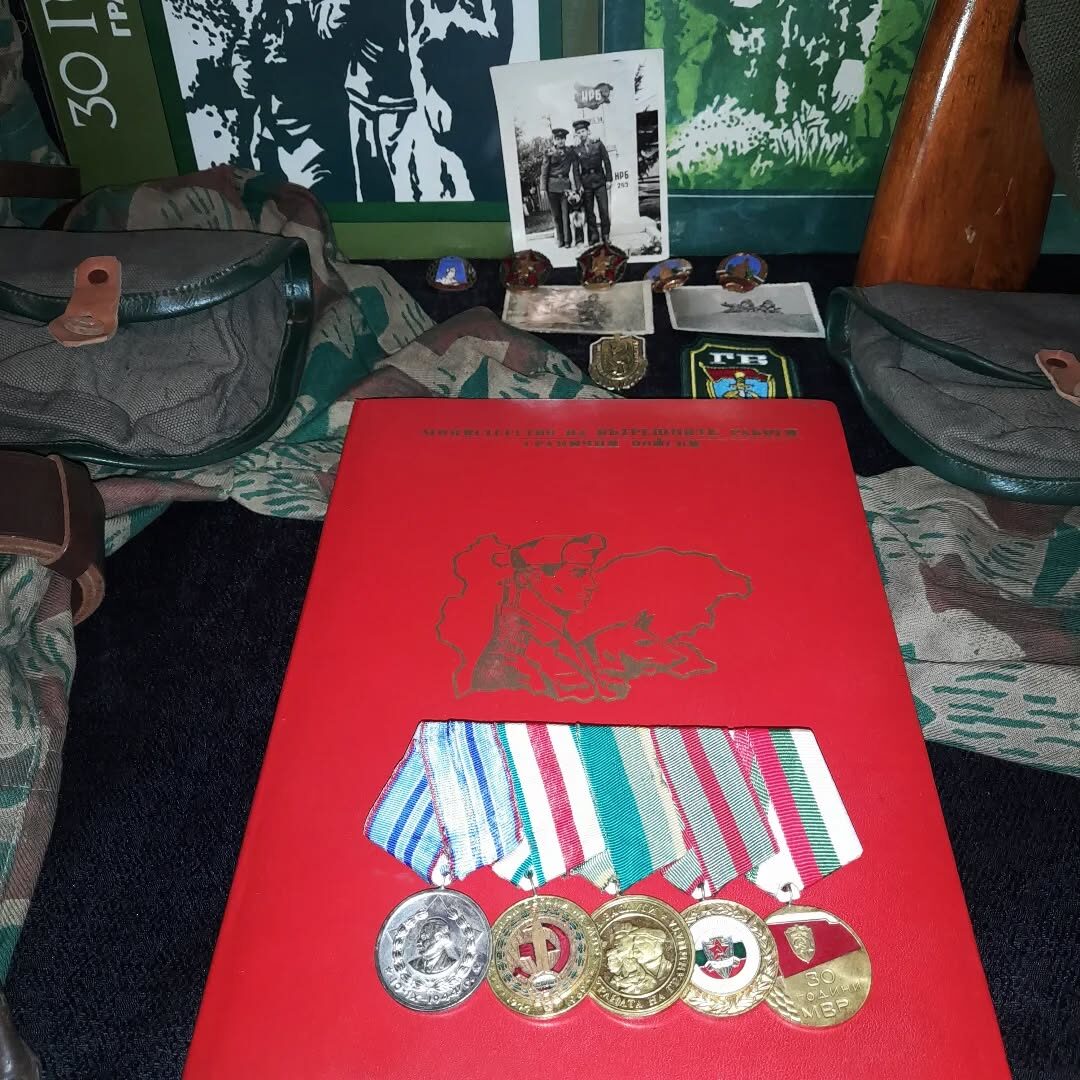 Bar of five medals of a former border guard, on a Ministry of the Interior shirt, Border Troops — Collection Cold War Bulgaria
It is little enough and it is a great deal. These objects were kept because they spoke of a life well filled: the selection passed, the years in the mountains, the esteem of the village. The prestige was real, it was not invented afterwards, and the men who bore it had not chosen their country's geopolitics.
The museum does not have to decide between the honour of a corps and the function of a border. It has to show that both fitted inside the same uniform.
Facts verified against sources: the law of 10 August 1946 creating the Border Militia and placing it within the Ministry of the Interior, publication on 27 August, renaming as Border Troops on 8 October 1946; subordination to the Ministry of National Defence from 1962 to 1972 and the retention of the border posts by the Interior during that period; twenty-one documented cases of East German citizens killed at the Bulgarian border, at least six hundred and ninety-five successful crossings, more than one thousand five hundred attempts foiled, the death of Michael Weber in July 1989; the renaming of the passport offices as border control posts on 1 January 1948 and their attachment to the directorate of the Border Troops; the difficulty of establishing the figures noted by the historian Stoyan Raychevski and the existence of higher estimates. Resting on an oral account and not on a documentary source: the recruitment method described in the section "The best of the boys", flagged as such in the text. Resting on a reading of the objects: the identification of the records and the framed reproduction, as well as the attribution of the kit shown to the Border Troops rather than to another unit.