The Silicon Valley of the bloc
Thematic dossier · Period: 1960–1989 · Reading time: 9 min
Forty per cent of the bloc's computers, a man in space, and an industry gone in three years.
Towards the end of the 1980s, Bulgaria supplied around forty per cent of the computers in circulation in the Comecon countries. Its electronics industry employed three hundred thousand people and generated eight billion roubles a year.
This fact is little known, including among younger Bulgarians. It nonetheless deserves to open this dossier, because it contradicts more or less everything one imagines of a small agricultural Balkan country turned Soviet satellite.
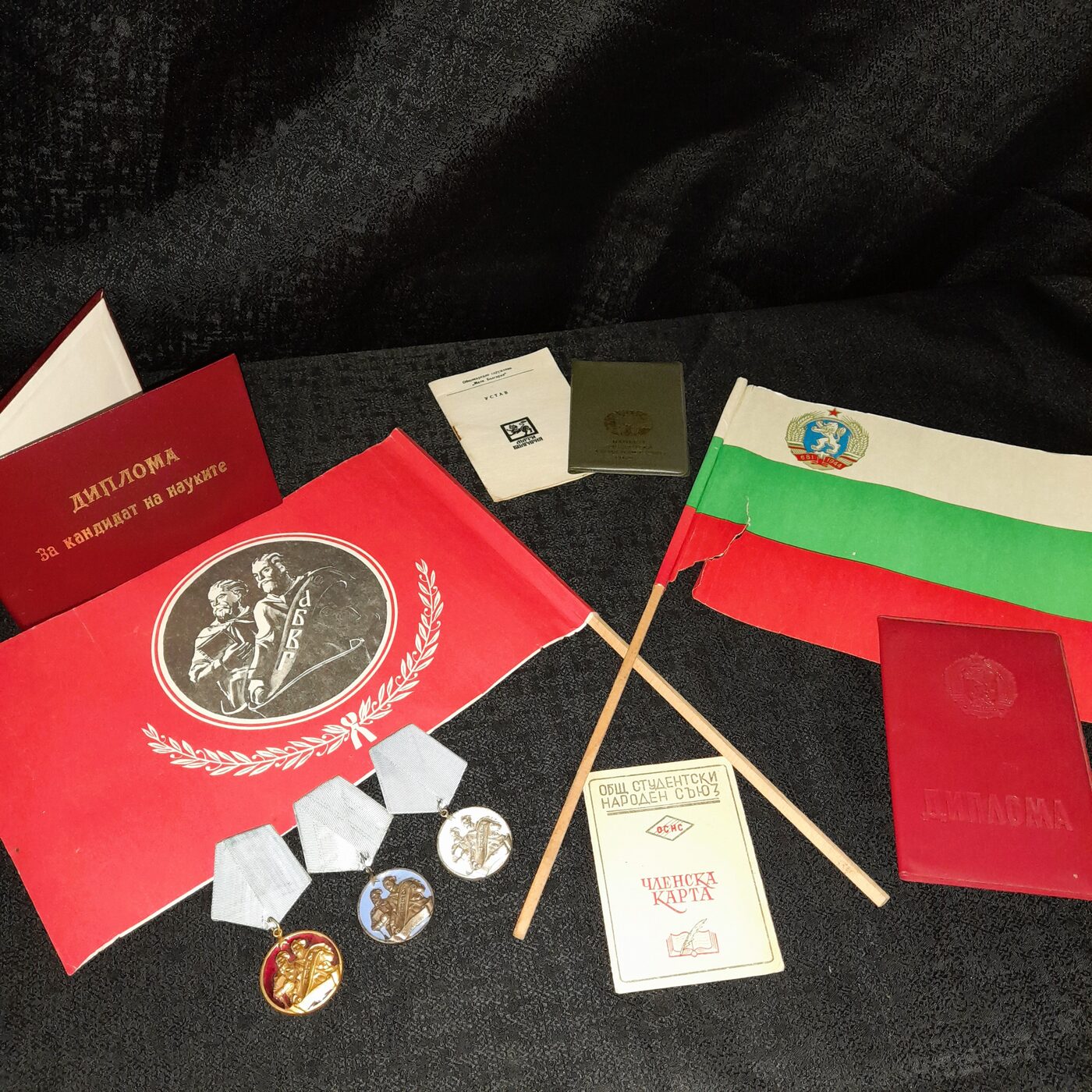 Candidate of Sciences diploma, membership card of the General People's Union of Students, statutes, medals and flags — Collection Cold War Bulgaria
Manufacturing scholars
It begins with people.
The red diploma shown here bears the designation "Candidate of Sciences", the first doctoral degree in the Soviet-inspired academic system, obtained after a thesis and its defence. Beside it, the membership card of the General People's Union of Students and the statutes of an association.
These objects describe a whole trajectory: the university, the student organisation, then the academic title. The training of researchers was not a by-product of the system, it was a planned objective. A country that wants to produce computers must first produce engineers, and that takes a generation.
The pennant bearing the likenesses of Cyril and Methodius, the two monks who created the alphabet, is not decorative in this context. Bulgaria celebrated learning as a national tradition predating the regime, and the regime placed itself within that continuity rather than replacing it.
The electronics wager
The industrial history is also a history of political calculation.
Bulgaria committed itself to electronics under the impetus of Ivan Popov, a scientist and manager to whom this success is largely attributed. The key was not only technical: it consisted in renegotiating the country's place within the Council for Mutual Economic Assistance, in cooperating as much as competing with the other members of the bloc, and above all in identifying the technological needs of the dominant power. The result was what researchers call the capture of the Comecon market.
The calculation is summed up by a phrase attributed to Zhivkov: Bulgaria is doing well because it has colonies, and the largest is the USSR.
This success had a less glorious foundation. Many Bulgarian machines were reverse-engineered adaptations of Western architectures, assembled with Eastern bloc components. The first microcomputer, the IMKO-1, dates from 1979; its production version, renamed Pravetz (Правец) 82 and produced from 1982, was compatible with Apple II software.
The factory was set up at Pravets, the birthplace of Todor Zhivkov, who personally backed the project.
The brands of everyday life
This industry left its mark on the most ordinary objects, and that is what one sees in the collection.
One name recurs constantly: ELPROM. It appears on a railwayman's signal lamp, on a Bakelite radio set, on civilian torches. Beside it, other state enterprise names: RESPROM for a TA 900 desk telephone, Svetlina for lamps, Electron for a Militia radio set, TONMASTER for a subscriber's loudspeaker.
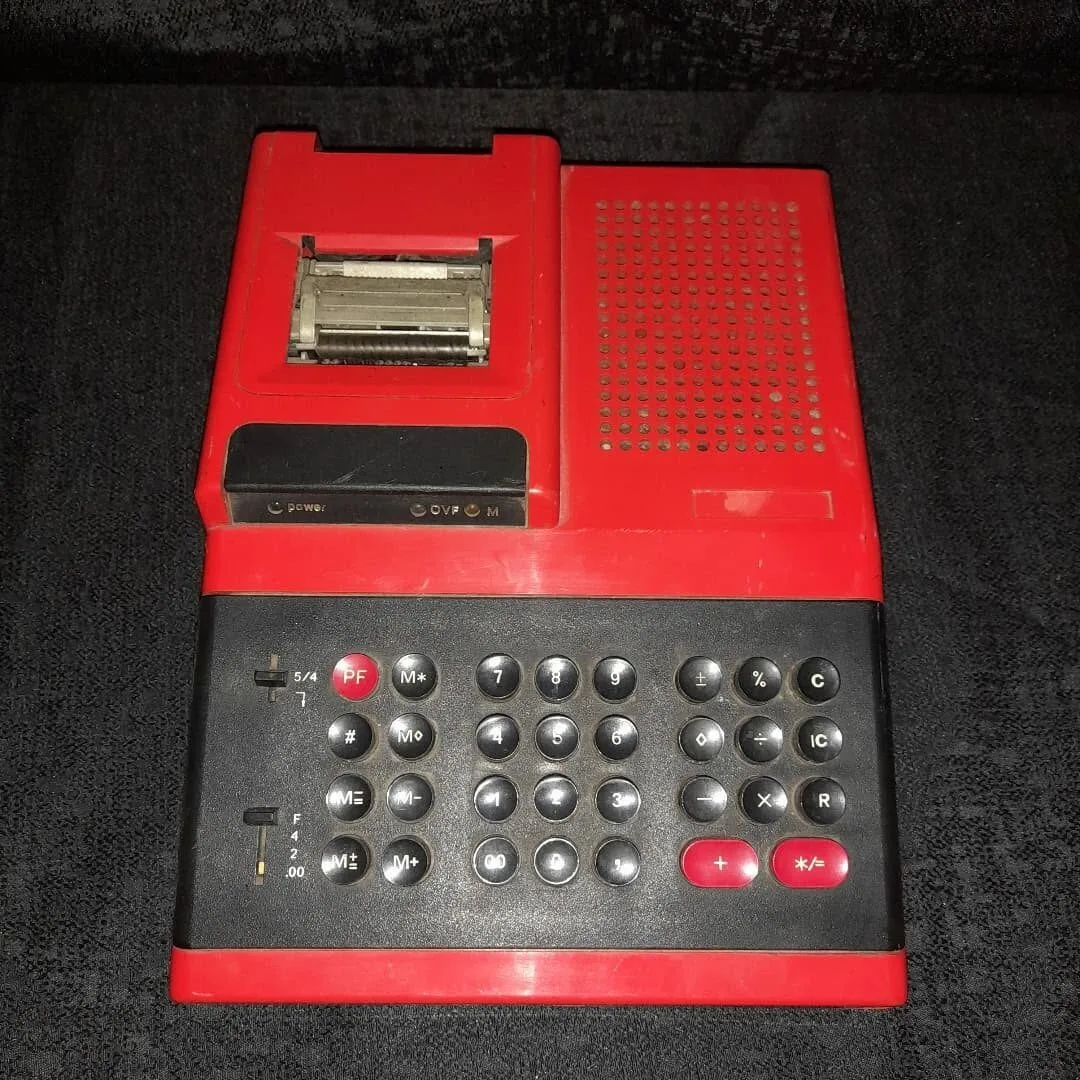 The well-known Bulgarian calculator for cashiers and accountants — Collection Cold War Bulgaria
This mechanical calculator belongs to the world before the Pravetz machines, that of office calculation. It did the work of accountants for decades, in a country that would soon be exporting computers.
Telephony offers the best example of this national production, because its evolution can be followed over three decades.
 Bakelite telephone of the TA-64 type, dated 1965 — Collection Cold War Bulgaria
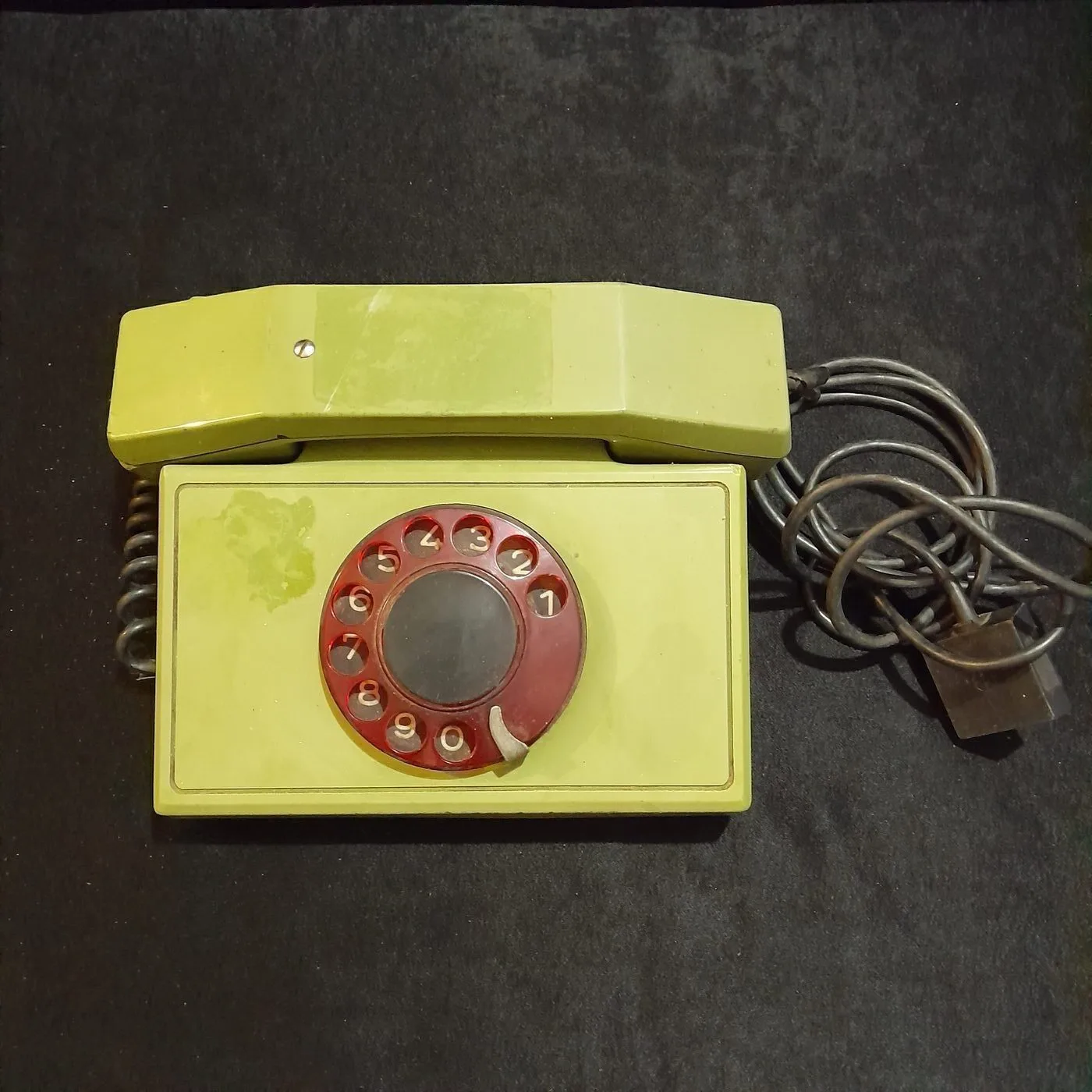 RESTPROM desk telephone, model TA 900 — Collection Cold War Bulgaria
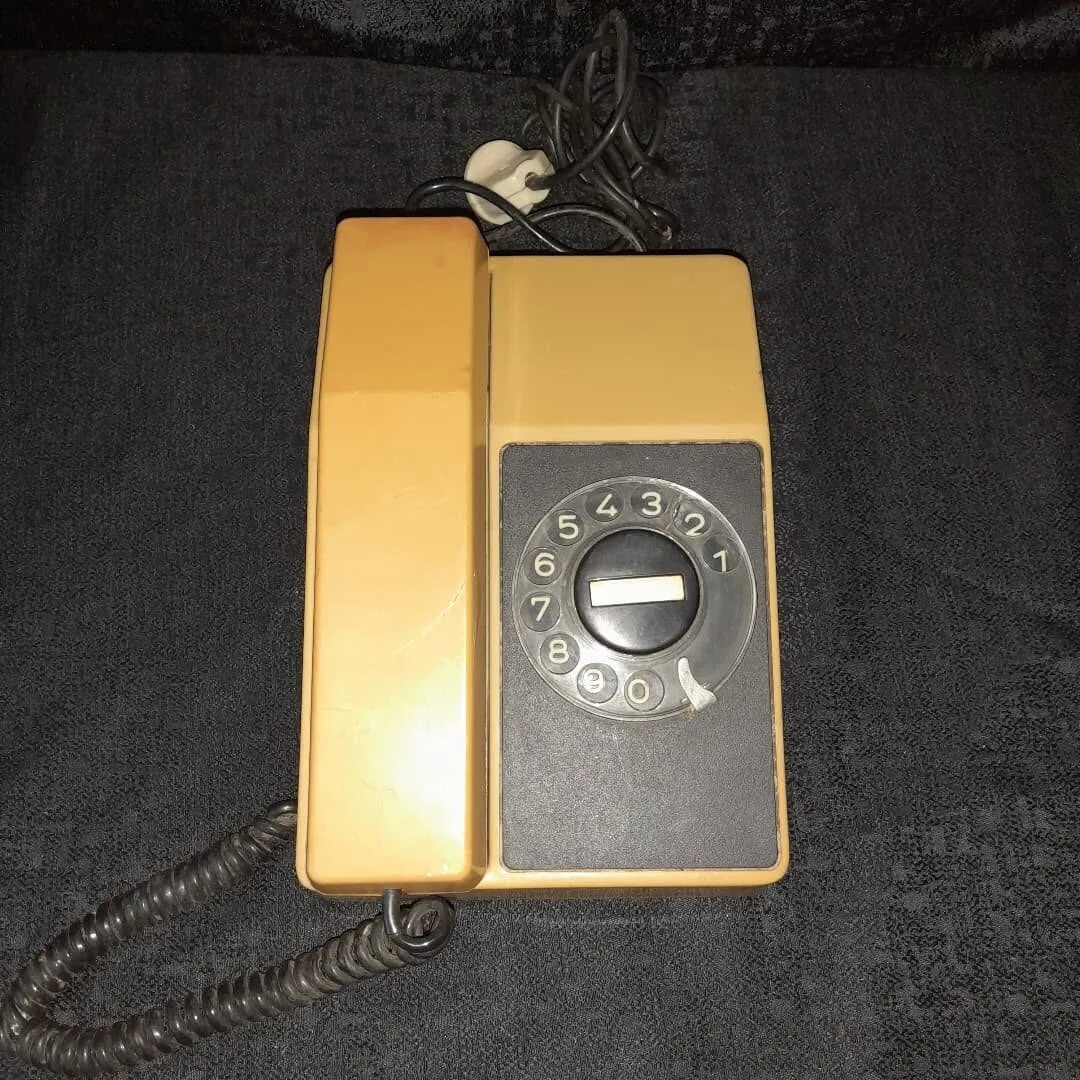 Bulgarian civilian telephone RESTPROM TA-700, dated 1987 — Collection Cold War Bulgaria
A Bakelite casing from 1965, a desk model, a 1987 device: the same function, three successive states of Bulgarian manufacture. The materials change, the shapes lighten, the rotary dial remains.
And at the end of the line, there is the object that connects them all.
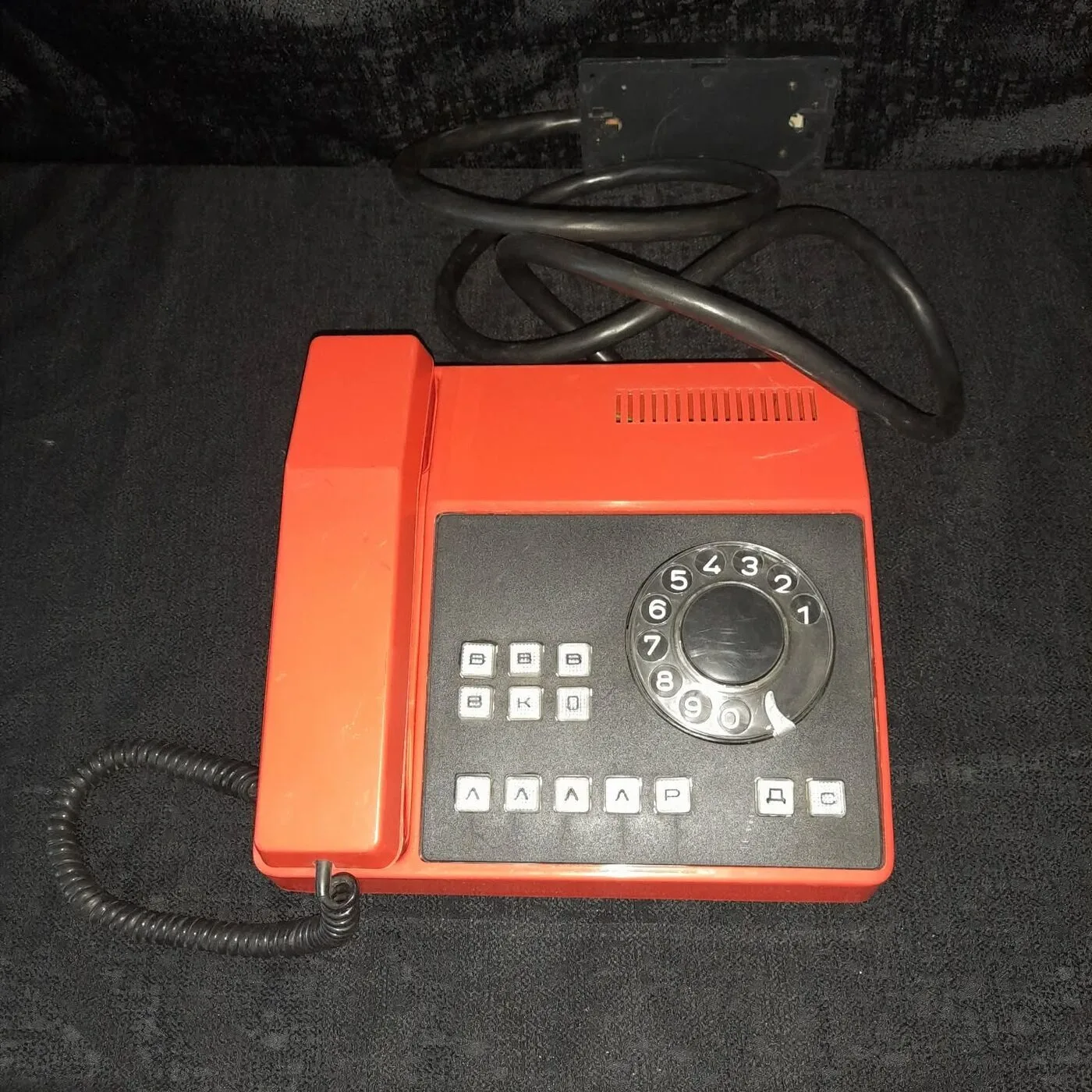 Telephone exchange of the CHDC 4-3-4M type — Collection Cold War Bulgaria
A telephone exchange is not a domestic appliance: it is infrastructure. Manufacturing one belongs to an altogether different industrial level from assembling handsets. A country that produces its own exchanges does not merely equip households, it builds its network — and that is precisely the kind of capability that prepared the ground for electronics.
Thirty-one orbits
On 10 April 1979, a Bulgarian left the Earth.
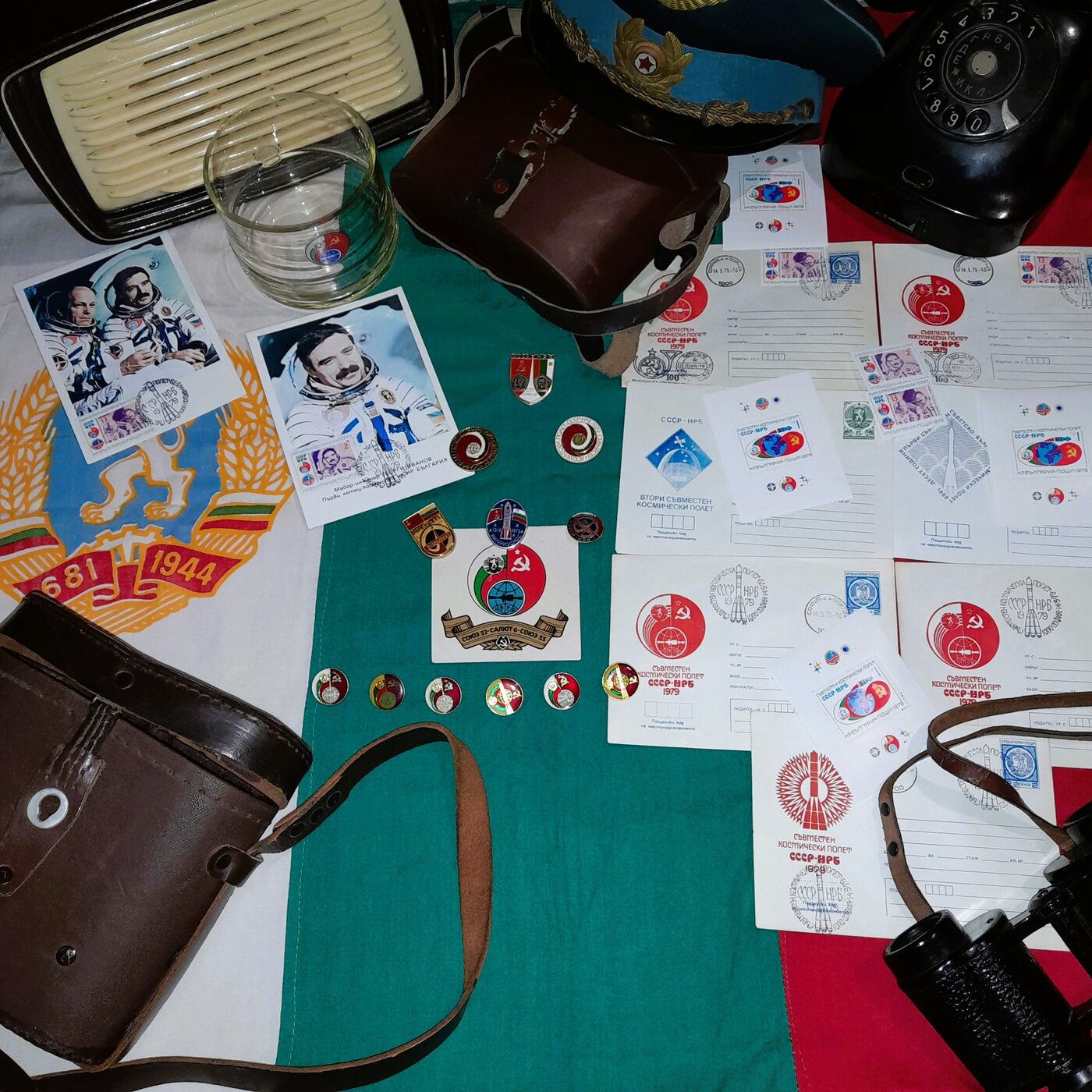 Objects commemorating the joint Soviet-Bulgarian spaceflight of 1979: postcards of the cosmonauts, badges, philatelic covers and stamps — Collection Cold War Bulgaria
Georgi Ivanov lifted off from Baikonur aboard Soyuz 33, with the Soviet Nikolai Rukavishnikov as commander. Bulgaria became the sixth country in the world to have a citizen in space. The flight's scientific programme had been prepared entirely by Bulgarian researchers, as had part of the equipment.
The scale of the commemoration can be measured in this still life. First-day covers, stamps, postcards of the two men in spacesuits, enamelled badges by the dozen, all struck with the double emblem СССР-НРБ: USSR and People's Republic of Bulgaria. A two-day flight produced more commemorative objects than most Party congresses.
Yet what this mission really was must be told.
On approaching the Salyut 6 station, the main engine was fired for a burn that was to last six seconds. It stopped after three. The station's crew saw flames shooting sideways from the engine. Docking was impossible: it was the first failure of a Soyuz engine in orbital operations.
The return was made by ballistic re-entry, with decelerations exceeding nine times gravity. Both men were recovered alive. Ivanov had completed thirty-one orbits, on a flight of less than two days, the shortest of the Interkosmos programme.
What followed is a textbook case of state communication. On their return, the docking failure was attributed to a technical incident, suggesting a failure of the docking system, without ever mentioning the real danger the cosmonauts had faced. The country was celebrating a triumph without knowing it had come close to being a disaster.
One detail completes the picture of the era: a few days before the flight, Ivanov had had to give up officially his surname, Kakalov, judged ill-sounding in Russian, and take his father's.
A second Bulgarian, Alexander Alexandrov, would spend ten days aboard the Mir station in 1988 and conduct a series of scientific experiments there.
What modernising meant
One must guard against too flattering a reading as much as against too severe a one.
The massive and poorly controlled investment in heavy industry in the 1950s had left the country with equipment already outdated and too costly to replace, rendering a large part of that industry uncompetitive. The electronics wager of the late 1970s was in part an answer to this impasse.
And it worked, in its way. Pravetz computers equipped schools, offices and laboratories; by the end of the 1980s, it was said that Bulgarian pupils had access to more computers in the classroom than in any other Eastern European country.
But this success rested on a captive market and on borrowed designs. As soon as Bulgaria left central planning and opened its markets, it could no longer manufacture or sell these machines. The industry disintegrated almost entirely.
The legacy
Something remains nonetheless, and it is perhaps the most interesting part of the story.
Once the economy was liberalised, some of the country's first private enterprises were computing companies, founded and run by the very people who had tinkered on Pravetz machines at school. A certain number left for Silicon Valley, taking with them a scientific training and a taste for technique.
That is the paradox of this dossier. Most of the systems presented in this museum disappeared with the regime that produced them: the youth organisations, the membership books, the congresses, State Security. Technical knowledge, for its part, survived its framework.
A Candidate of Sciences diploma is no longer worth anything administratively. What its holder had learned in order to obtain it did not cease to exist on the day the first article of the Constitution was repealed.
Facts verified against sources: Bulgaria's supply of around forty per cent of the computers in circulation in the Comecon countries at its peak; the employment of three hundred thousand people in the electronics industry and the generation of eight billion roubles a year; the role of Ivan Popov as the scientist and manager behind the success, and the strategy of renegotiating Bulgaria's place within Comecon leading to the capture of that market; the phrase attributed to Todor Zhivkov about Bulgaria's colonies and the USSR, reported by the source as a supposed quotation; the construction of machines by reverse-engineering Western architectures assembled with Eastern bloc components; the first microcomputer IMKO-1 in 1979, series production of the IMKO-2 renamed Pravetz 82 from 1982, compatibility with Apple II software, and the siting of the factory at Pravets, Zhivkov's birthplace, who supported the project; the poorly controlled investment in heavy industry in the 1950s having left outdated equipment too costly to replace; the deployment of Pravetz machines in schools, offices and laboratories, and the claim of a school equipment rate higher than in other Eastern European countries, reported by the source as a reputation and not as a measurement; the disintegration of the industry after the opening of the markets; the founding of the first private computing companies by former school users of the Pravetz and the departure of a number of them for Silicon Valley. On the 1979 flight: the lift-off of Soyuz 33 on 10 April 1979 from Baikonur with Georgi Ivanov and Nikolai Rukavishnikov, the rank of sixth country in the world to send a citizen into space, the preparation of the scientific programme and of part of the equipment by Bulgarian researchers; an engine burn planned for six seconds interrupted after three, lateral flames observed from Salyut 6, the first failure of a Soyuz engine in orbital operations, docking impossible; ballistic re-entry with decelerations above nine g, the crew recovered unharmed, thirty-one orbits and the shortest flight of the Interkosmos programme; the official presentation of the failure as a technical incident suggesting a failure of the docking system, with no mention of the danger incurred; the change of surname imposed on Ivanov before the flight; Alexander Alexandrov's ten-day stay aboard Mir in 1988 with scientific experiments conducted. Resting on a reading of the objects photographed: the identification of the Candidate of Sciences diploma, of the General People's Union of Students card and of the pennant bearing the likenesses of Cyril and Methodius. Resting on the collector's description: the brands and uses of the ELPROM, RESPROM, Svetlina, Electron and TONMASTER objects, whose attachment to the state electrotechnical industry has not been verified enterprise by enterprise. The dating and attribution of the TA-64, TA 900 and TA-700 telephones and of the CHDC 4-3-4M exchange rest on the collector's descriptions; the industrial level implied by the manufacture of telephone exchanges is a general appraisal and not a fact established in sources for Bulgarian industry.